🎬 Doraemon: The Record of Nobita's Parallel Journey to the West (1988)
Part of Doraemon Movies
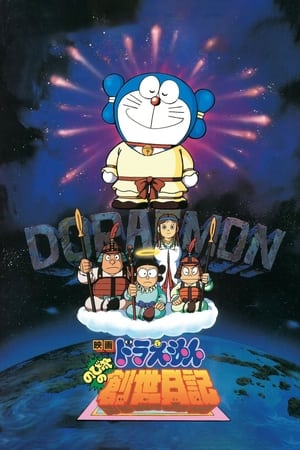
Released in 1988 as the ninth installment in the long-running Doraemon film series, "The Record of Nobita's Parallel Journey to the West" stands out as a particularly clever and meta-textual entry. Rather than simply dropping the characters into the classic Chinese novel, the film constructs a narrative where a virtual reality game based on Journey to the West malfunctions, allowing digital demons to escape and overwrite the real world. This science-fiction framing device is a perfect fit for Doraemon’s gadget-driven universe, transforming a literary classic into a high-stakes adventure where history itself is at risk of being permanently altered. The story kicks off with Nobita’s frustration at being denied the role of Sun Wukong in a school play, a personal slight that spirals into a full-blown temporal crisis after he attempts to prove the Monkey King’s existence by traveling to 7th-century China.
The film cleverly blurs the lines between fiction and reality within its own narrative. Nobita’s brief, ambiguous encounter with a boy who mistakes him for the real Wukong sets the stage for a plot where the legendary pilgrims—Tang Sanzang, Zhu Bajie, Sha Wujing, and the Monkey King himself—are not just fictional characters but historical entities whose existence is threatened by the escaped game demons. This allows the movie to have its cake and eat it too: the gang gets to interact with the iconic heroes of Journey to the West while the story remains firmly rooted in the Doraemon franchise’s trademark blend of time travel and technological mishaps. The visual design of the demons as glitchy, holographic entities reinforces the idea that this is a digital invasion, a concept that was quite forward-thinking for a children's anime film in the late 1980s.
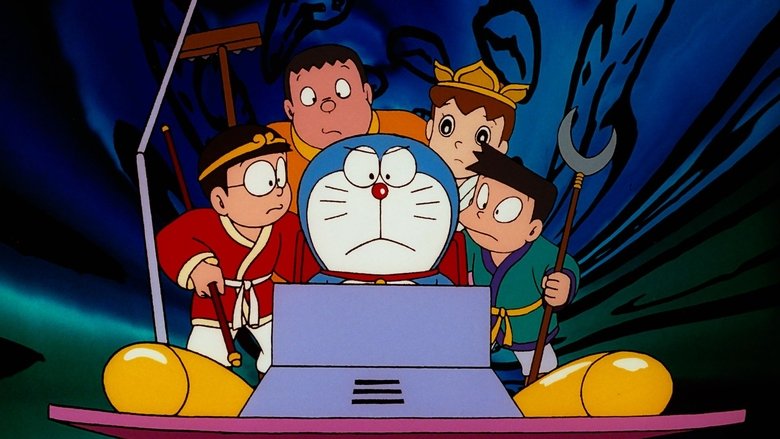
As with many Doraemon films, the heart of the story lies in Nobita’s personal growth. His initial jealousy over the school play casting gives way to genuine heroism as he is forced to step into the role he so desperately wanted, not on a stage, but in a battle for the fate of the world. The film was well-received upon its release, drawing impressive box office numbers that cemented the annual Doraemon movie as a staple of Japanese spring breaks. Its unique premise of a video game catastrophe predates similar themes that would become popular in anime and film years later, making it a distinctive and memorable chapter in the franchise’s history. For many fans, the image of the Doraemon gang dressed as the legendary pilgrims, fighting alongside the real Sun Wukong against pixelated monsters, remains one of the most iconic visuals of the early film series.
"The Record of Nobita's Parallel Journey to the West" was later remade as a video game for the PC Engine console, further extending its legacy. While the film is not directly based on a single Doraemon Long Story manga volume like many of its counterparts, it draws heavily from the established character dynamics and the series’ long tradition of placing its modern characters into historical or literary settings. It serves as a perfect example of how the Doraemon films could transcend simple adaptations, using classic tales as a springboard for original, imaginative, and emotionally resonant science-fiction storytelling.

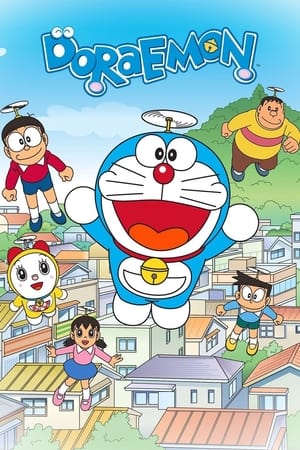
Doraemon is a Japanese manga series written and illustrated by Fujiko F. Fujio. It was first serialized in 1969 in various children's magazines published by Shogakukan. The story follows a robotic cat from the 22nd century named Doraemon, who is sent back in time to help a young boy named Nobita Nobi navigate the challenges of childhood and improve his future. Doraemon possesses a four-dimensional pocket from which he can produce futuristic gadgets, often leading to comedic and heartfelt adventures.
The manga chapters were collected into 45 tankōbon volumes between 1974 and 1996. Doraemon quickly became one of Japan's most beloved and iconic characters, winning numerous awards and achieving immense cultural significance. The series is considered a cornerstone of modern Japanese pop culture and has been a staple of children's entertainment for decades.
Beyond the manga, Doraemon spawned a massive media franchise including three anime television series, over forty animated feature films, video games, and a vast array of merchandise. The character has been recognized as a cultural ambassador for Japan and remains popular across Asia and globally, symbolizing friendship, imagination, and the wonders of technology.

The Doraemon film series is a long-running collection of animated feature films based on the beloved manga and anime franchise created by Fujiko F. Fujio. Beginning in 1980 with 'Doraemon: Nobita's Dinosaur', the series has become an annual tradition in Japanese cinema, with new installments released almost every spring. These films typically follow the titular robotic cat from the 22nd century and his young friend Nobita Nobi as they embark on extraordinary adventures across time, space, and fantastical realms, often utilizing Doraemon's ingenious gadgets from his four-dimensional pocket. While the original manga and television series focus on everyday slice-of-life scenarios, the movies expand the narrative scope, introducing higher stakes, epic journeys, and environmental or moral themes that resonate with family audiences. The series has evolved through different eras of animation and storytelling, with many early films being direct adaptations of manga storylines, while later entries explore original plots and even reimaginings of classic tales. This enduring collection has cemented Doraemon as a cornerstone of Japanese popular culture, with the films consistently drawing large audiences and contributing to the character's status as an official cultural ambassador of Japan.