📺 Batman (1966)
Part of Batman 66 Franchise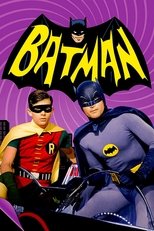
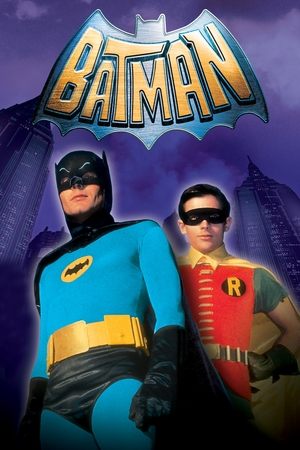
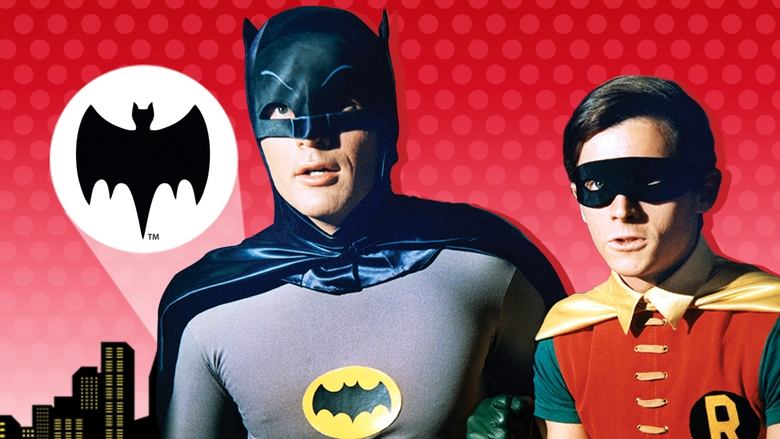
The 1966 'Batman' television series is a landmark in superhero media, transforming the Dark Knight of the comics into a pop-art phenomenon. Starring Adam West as Batman and Burt Ward as Robin, the show was a radical departure from the character's darker comic book origins, which began in 1939 with Bob Kane and Bill Finger's creation in Detective Comics #27. Instead of a grim avenger of the night, this Batman was a straight-laced, earnest do-gooder who operated in a world of bright colors, tilted camera angles, and on-screen sound effect graphics ('POW!' 'BAM!' 'ZAP!'). The series leaned heavily into a camp aesthetic, playing its absurd situations with a deadpan seriousness that delighted children and amused adults on a completely different level.
The show's format was unique, airing twice a week with cliffhanger endings that pitted the Dynamic Duo against a rogue's gallery of celebrity guest villains, including Cesar Romero's Joker, Burgess Meredith's Penguin, and Julie Newmar's Catwoman. The series was a massive, immediate hit upon its debut on ABC, sparking a wave of 'Batmania' that swept the nation. This success led to a theatrical feature film released between the first and second seasons, which saw the same cast facing off against a combined force of four supervillains. The series' influence on the public perception of Batman was so profound that it took decades for the character's darker roots to fully re-emerge in the mainstream consciousness, a shift spearheaded by Frank Miller's 1986 comic 'The Dark Knight Returns' and Tim Burton's 1989 film.
Though its popularity waned, leading to cancellation after three seasons and 120 episodes, the 1966 'Batman' series has never truly left the cultural landscape. It remains a beloved and endlessly quotable piece of television history, celebrated for its witty scripts, iconic theme song, and the definitive, if highly stylized, performances of its leads. The show is a time capsule of 1960s pop culture and a testament to the fact that a superhero can be successfully reinterpreted for a new generation, even if that interpretation is a complete and intentional inversion of the source material's original tone.
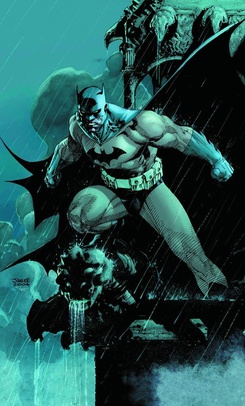
Batman is a fictional superhero created by artist Bob Kane and writer Bill Finger, first appearing in Detective Comics #27 in 1939. The character's secret identity is Bruce Wayne, a wealthy American playboy, philanthropist, and industrialist who resides in Gotham City. After witnessing the murder of his parents as a child, he swore revenge against criminals, an oath tempered by a sense of justice. Bruce Wayne trains himself physically and intellectually and crafts a bat-inspired persona to fight crime.
Unlike many superheroes, Batman possesses no superpowers; he relies on his genius intellect, physical prowess, martial arts abilities, detective skills, science and technology, vast wealth, intimidation, and indomitable will. A large ensemble cast of supporting characters includes his sidekick Robin, butler Alfred Pennyworth, and Police Commissioner James Gordon, as well as a rogues' gallery of villains including the Joker, Penguin, Harley Quinn, and Poison Ivy.
Batman quickly became one of DC Comics' most popular characters and has been adapted into numerous media, including film, television, animation, and video games. The character's dark, brooding nature and complex psychology have made him a cultural icon recognized worldwide, representing the archetype of the vigilante hero who operates outside the law to achieve justice.

The Batman '66 collection is a vibrant and beloved chapter in the Dark Knight's history, representing a complete departure from the character's grim, pulp origins and his later, darker reinventions. Born from the 1966 live-action television series starring Adam West and Burt Ward, this collection transformed the Caped Crusader and the Boy Wonder into full-fledged pop-art phenomena. It wasn't just a superhero show; it was a kaleidoscopic, day-glo celebration of high camp, deadpan absurdity, and unapologetic earnestness, where the greatest threats were elaborate deathtraps, giant props, and the fiendish puzzles left behind by a rogues' gallery of overacting guest stars. The collection's signature aesthetic—saturated colors, tilted camera angles, and onomatopoeic 'POW!' and 'BAM!' fight graphics—cemented a version of Gotham City that was less a dark urban hellscape and more a swinging, mod playground for costumed characters to engage in gloriously silly battles of wits.
The cornerstone of this universe is the theatrical film *Batman: The Movie*, released between the show's first and second seasons. The film escalated the series' formula to a cinematic scale, uniting four of the Dynamic Duo's most prominent foes—the Joker, the Penguin, the Riddler, and, for the first time in live-action, Catwoman, played by Lee Meriwether. Their diabolical plot to dehydrate the United World Organization's Security Council into colorful piles of dust perfectly encapsulates the collection's love for ludicrous, world-threatening schemes solved only through the power of a well-timed Bat-gadget and a healthy dose of moralizing. This era's influence is immeasurable, permanently embedding itself into the public consciousness and defining the very concept of a 'superhero' for an entire generation, even as it controversially became the standard against which all darker comic book adaptations would later rebel.
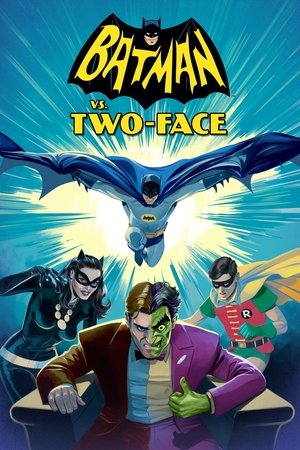
The legacy of Batman '66 extends beyond its original run, proving the timeless appeal of its bright and optimistic heroism. The collection expanded with the introduction of Yvonne Craig's Batgirl in the television series' third season, a character who brought a new dynamic to the crime-fighting trio and became a feminist icon in her own right, matching wits and athleticism with her male counterparts. More recently, the collection has experienced a vibrant revival, continuing its narrative in comic book form and through two animated feature films, *Return of the Caped Crusaders* and *Batman vs. Two-Face*. These modern continuations, with Adam West and Burt Ward returning to voice their legendary roles, served as a poignant love letter to the collection's enduring charm, proving that beneath the spandex, the shark repellent, and the insatiable urge to do the Batusi, the heart of Batman '66 beats with a pure, sincere, and utterly delightful sense of fun.