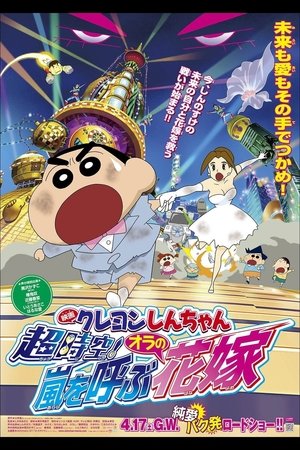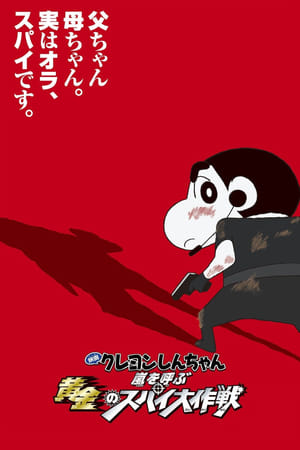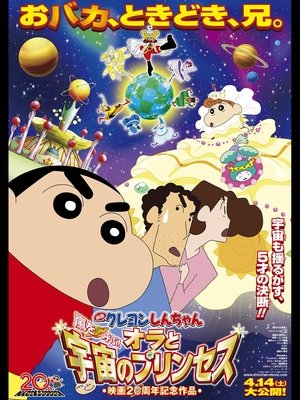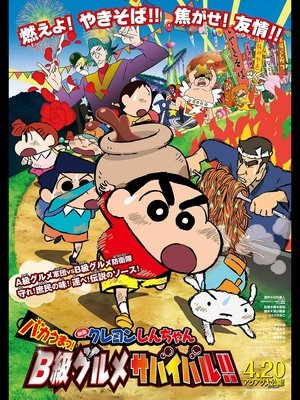
🎬 Crayon Shin-chan: Honeymoon Hurricane ~The Lost Hiroshi~ (2019)
Part of Crayon Shin-chan
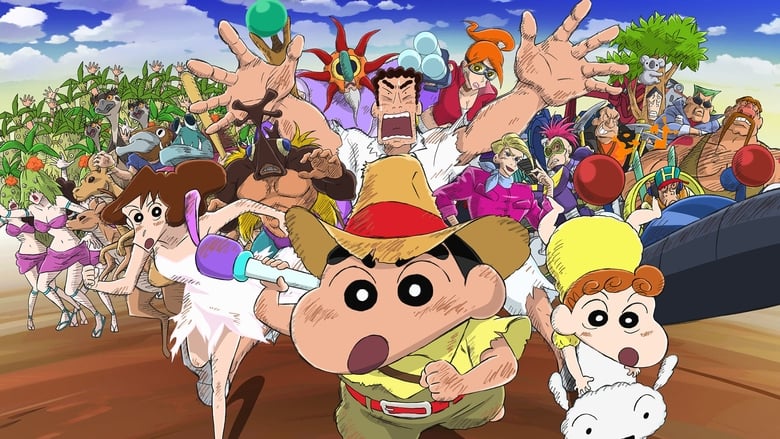
Released in 2019, "Crayon Shin-chan: Honeymoon Hurricane ~The Lost Hiroshi~" marks a significant milestone as the 27th film in the long-running franchise and the final entry of the Heisei era. Directed by Masakazu Hashimoto, the film cleverly uproots the Nohara family from their familiar suburban antics in Kasukabe and transplants them into a high-stakes adventure in Australia. The premise is classic Shin-chan: a comically mundane motivation—Misae finding a cheap honeymoon package—spirals into an international treasure hunt when the family patriarch, Hiroshi, is kidnapped. This setup allows the film to explore a dynamic rarely seen in the series, placing the often-bickering but deeply loyal family in an unfamiliar, dangerous environment where they must rely on each other more than ever.
The film is notable for its shift in tone, blending the franchise's signature crude humor and slapstick with a genuine action-adventure narrative reminiscent of an Indiana Jones caper. While the source manga typically focuses on slice-of-life vignettes and domestic chaos, this adaptation leans heavily into a serialized, globe-trotting plot. The characterization of Hiroshi is central to the story's emotional core; he is not just the butt of jokes but a man whose seemingly ordinary existence holds the key to a legendary treasure, giving the character a rare moment of heroic significance. This focus on the father figure provides a heartfelt counterbalance to the absurdity, reinforcing the series' underlying theme of familial bonds.
This entry also carries historical weight for the franchise's production. It was the first full film to feature Yumiko Kobayashi as the voice of Shinnosuke following her taking over the role in the television series in 2018, making it a crucial test for audience acceptance of the new voice in a cinematic format. The film's release just weeks before the 2019 Japanese imperial transition from Heisei to Reiwa gives it a unique place in the timeline, serving as a bookend to an era of the anime's history. Its distribution also marked the end of an era in parts of Southeast Asia, being the last film handled by Odex before the rights transitioned to Muse Communication, a detail that underscores the shifting landscape of anime licensing at the time.

Crayon Shin-chan is a Japanese manga series written and illustrated by Yoshito Usui. It was first serialized in 1990 in the magazine Weekly Manga Action, published by Futabasha. The series follows the daily life and misadventures of Shinnosuke "Shin-chan" Nohara, a mischievous, often inappropriate five-year-old boy living in Kasukabe, Saitama Prefecture, with his family. The humor derives largely from Shin-chan's bizarre observations, linguistic misunderstandings, and his knack for embarrassing his parents in public.
Following the tragic death of Yoshito Usui in 2009, the original manga concluded. However, the franchise proved so popular that a continuation, titled New Crayon Shin-chan, began publication in 2010, created by Usui's former assistants. The manga's unique blend of crude humor, social satire, and genuine family warmth resonated deeply with readers, making it one of the best-selling manga series of all time, with over 148 million copies in circulation.
The manga spawned a massive media franchise, most notably a long-running anime television series that began airing in 1992 and continues to this day. The franchise also includes a highly successful series of annual animated feature films, video games, and a vast array of merchandise. Crayon Shin-chan has become a cultural icon in Japan and has achieved significant international popularity, dubbed into dozens of languages worldwide.
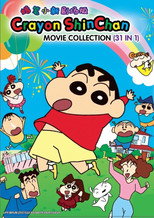
Few animated series have captured the chaotic, unfiltered energy of childhood quite like *Crayon Shin-chan*. Born from the mischievous pen of Yoshito Usui in 1990, the series centers on Shinnosuke "Shin" Nohara, a gleefully inappropriate five-year-old whose antics constantly upend the quiet suburb of Kasukabe. With his signature cheeky grin, bizarre improvised dance, and a knack for mortifying his parents, Shin became an instant cultural phenomenon, transforming everyday family life into a canvas for sharp social satire and unbridled slapstick. The franchise’s genius lies in its dual identity: on the surface a crude, laugh-out-loud comedy for children, yet layered with a wry, often nostalgic commentary on Japanese middle-class life that resonates deeply with adults.
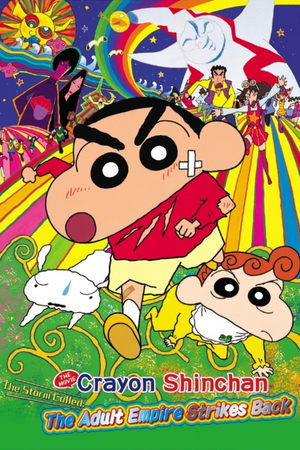
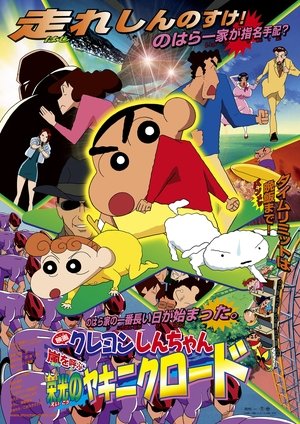
The manga’s staggering success—selling over 148 million copies—swiftly translated into a sprawling multimedia empire anchored by a continuously running television series since 1992 and a beloved tradition of annual feature films. These theatrical adventures often catapult the Nohara family out of their domestic mishaps and into high-stakes genre playgrounds, pitting them against everything from supernatural forces and sci-fi dystopias to historical samurai. Landmark films like *The Adult Empire Strikes Back* elevated the series to critical acclaim, weaving bittersweet reflections on nostalgia into a child’s adventure, while others like *The Glorious Storm-invoking Yakiniku Road* showcase the franchise’s unique ability to build entire sagas around absurd, mundane cravings. This cinematic legacy has cemented the films as a vital, inventive counterpart to the weekly sitcom format.
Tragically interrupted by Usui’s passing in 2009, the franchise demonstrated remarkable resilience, continuing as *New Crayon Shin-chan* under his former assistants and maintaining its status as a cultural institution. The series has never lost its fearless edge, effortlessly bouncing between toilet humor and surprisingly tender moments of familial love, all while Shin’s voice remains a generational constant in Japanese pop culture. With over 30 films, countless video game adaptations, and spin-offs, *Crayon Shin-chan* endures as a uniquely unvarnished portrait of modern life, proving that the ungovernable id of a five-year-old can be both a devastatingly funny mirror to society and a timeless engine for storytelling.