🎬 Justice League: Warworld (2023)
Part of Justice League (Tomorrowverse)
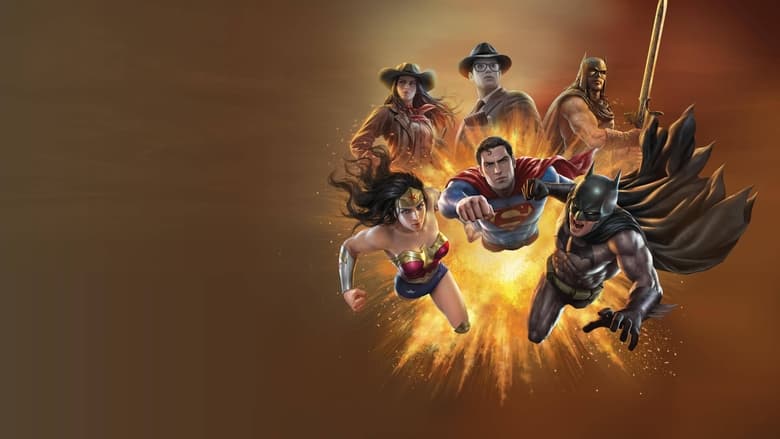
Justice League: Warworld marks a fascinating departure for the Tomorrowverse animated continuity, trading the typical cosmic spectacle for a genre-bending anthology structure. Rather than a straightforward adaptation of a single comic storyline, the film cleverly reimagines the classic Justice League trinity—Batman, Superman, and Wonder Woman—by trapping them in disparate, self-contained realities that evoke classic American pulp genres. The narrative unfolds across a barbaric sword-and-sorcery landscape, a black-and-white 1950s alien invasion paranoia thriller, and a dusty Wild West standoff. This fragmented approach allows the film to explore the core identities of its heroes when stripped of their memories and usual support systems, forcing them to rely on their innate moral compasses before the larger, unifying threat of the tyrannical Warworld is fully revealed.
The film’s greatest strength lies in its atmospheric world-building and its willingness to let each vignette breathe with its own distinct visual and tonal style. The segment featuring a noir-inspired Batman investigating a mysterious murder in a retro-futuristic setting is a particular highlight, leaning into the character's detective roots in a way rarely seen in the more action-oriented animated features. The voice cast, led by Jensen Ackles as a grizzled, amnesiac Batman, Darren Criss as a morally upright Superman, and Stana Katic as a fierce, questioning Wonder Woman, delivers grounded performances that sell the internal confusion of characters who have lost everything but their instincts. The slow-burn mystery of how these separate timelines connect to the gladiatorial world of Mongul’s Warworld keeps the tension simmering until the final act.
As a sequel within the broader Tomorrowverse saga, Justice League: Warworld functions as a crucial, character-driven bridge to the monumental Crisis on Infinite Earths trilogy that followed. While some viewers expecting a traditional Justice League team-up may have been surprised by the heroes’ prolonged separation, the script by Jeremy Adams, Ernie Altbacker, and Josie Campbell uses this isolation to deconstruct what makes the League essential. The film posits that even without their memories, the heroes are inexorably drawn to fight tyranny, a theme that pays off when the trinity finally unites. The depiction of Warworld itself is less a planet and more a psychological prison, a narrative choice that distinguishes this adaptation from more literal translations of the source material.
Upon its release in July 2023, the film received a mixed but intrigued reception, praised for its ambitious narrative structure and mature tone, though some critics noted the pacing suffered from the segmented format. It stands as one of the more experimental entries in the DC Universe Animated Original Movies line, prioritizing thematic depth and character study over non-stop action. By blending Western, noir, and fantasy tropes with the mythos of the Justice League, Warworld successfully captures the timeless, archetypal nature of these heroes, proving they can thrive in any reality, no matter how strange or hostile.

The Justice League is a legendary superhero team in DC Comics, first appearing in The Brave and the Bold #28 in 1960, created by writer Gardner Fox and artist Mike Sekowsky. The team unites DC's most iconic heroes—Superman, Batman, Wonder Woman, the Flash, Green Lantern, Aquaman, and Martian Manhunter—to combat threats too powerful for any single hero. Inspired by the Justice Society of America from the 1940s, it marked a new era of team-up adventures during the Silver Age of Comics, emphasizing unity, heroism, and epic battles against villains like Starro the Conqueror and the Injustice Gang.
Over decades, the Justice League evolved through various lineups, story arcs, and creative teams, exploring themes of leadership, sacrifice, and the balance between power and morality. Key runs include the 1980s era by Keith Giffen and J.M. DeMatteis, which added humor and ensemble dynamics, and Grant Morrison's 2000s JLA, which restored the core roster and tackled cosmic-scale crises. The team's cultural impact is immense, spawning countless spin-offs, influencing pop culture, and symbolizing the ultimate alliance of good against evil.
The Tomorrowverse is a shared universe of animated superhero films produced by Warner Bros. Animation and DC Entertainment. It serves as a successor to the DC Animated Movie Universe, launching with a fresh continuity and a distinct retro-futuristic aesthetic inspired by classic comic book artwork. The overarching narrative explores the formation of the Justice League and the escalating cosmic threats they face, building toward a multiversal crisis.
This collection of films is characterized by its interconnected storytelling, where events in one film directly influence subsequent entries. The visual style is notably cleaner and more streamlined than its predecessor, emphasizing bold lines and a vibrant color palette. The stories often draw inspiration from iconic DC Comics storylines, reinterpreting them to fit the new animated continuity.
The Tomorrowverse places a strong emphasis on legacy and the concept of heroism across different eras. It introduces alternate realities and historical teams like the Justice Society of America, weaving them into the fabric of the modern heroes' journey. The narrative arc gradually expands from Earth-bound conflicts to galaxy-spanning wars, ultimately culminating in a reality-shattering event that tests the limits of the Justice League's unity and power.