🎬 Private Romeo (2011)
Based on play/musical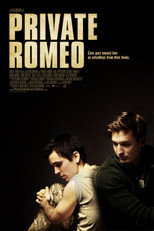
Alan Brown's 2011 film "Private Romeo" relocates the timeless tragedy of star-crossed lovers to the rigid, isolated environment of an all-male military academy, transforming Shakespeare's verse into a poignant commentary on forbidden love under the shadow of the U.S. military's "Don't Ask, Don't Tell" policy. The narrative cleverly frames the recitation of the play as a classroom exercise, but the lines soon bleed into reality as cadets Sam Singleton and Glenn Mangan find their off-stage feelings mirroring the passion and peril of Romeo and Juliet. The film uses a striking visual language to distinguish these two worlds: the drab, desaturated tones of academy life give way to richly saturated colors whenever the characters step into their Shakespearean roles, visually underscoring how the heightened language of the play gives voice to emotions they are otherwise forced to suppress.
The adaptation is notable for its minimalist approach, stripping the play down to its essential emotional core and using a cast of only eight actors to portray multiple roles, with many of the original characters omitted entirely. This narrative economy sharpens the focus on the central romance between Sam (Seth Numrich) and Glenn (Matt Doyle), while the surrounding cadets embody the societal pressures and watchful eyes that doom the relationship. The military setting adds a layer of institutionalized repression, making the feud between the Montagues and Capulets feel less like a family squabble and more like an inescapable, systemic force. Brown was inspired to write the script after seeing Joe Calarco's play "Shakespeare's R&J," which similarly explores young men discovering themselves through the text, but "Private Romeo" grounds this concept in a specific, politically charged context.
Premiering just as "Don't Ask, Don't Tell" was finally being repealed, the film arrived at a potent cultural moment, serving as both a lament for the damage the policy caused and a hopeful, if tragic, portrait of love finding expression against all odds. The use of Shakespeare's original dialogue, spoken entirely by young men, highlights the universality of the play's themes while also queering the text in a way that feels organic and deeply moving. "Private Romeo" is less a direct adaptation and more a resonant dialogue with the source material, proving that the agony of Verona can be just as devastating when played out on a drill field.

Romeo and Juliet is a tragedy written by William Shakespeare early in his career, believed to have been composed between 1591 and 1595. It tells the story of two young star-crossed lovers whose deaths ultimately reconcile their feuding families in the Italian city of Verona. The play is among Shakespeare's most popular works and, alongside Hamlet, remains one of his most frequently performed plays.
The plot draws on a long tradition of tragic romances stretching back to antiquity. Shakespeare's immediate sources were Arthur Brooke's 1562 narrative poem The Tragical History of Romeus and Juliet and William Painter's 1567 prose version in Palace of Pleasure, both of which derived from an Italian tale by Matteo Bandello. Shakespeare expanded the story significantly, developing supporting characters like Mercutio and Paris, and employing a sophisticated poetic structure that shifts between comedy and tragedy.
The play was first published in a quarto edition in 1597, though this early text was of poor quality. A more authoritative version appeared in the 1599 quarto. The title characters have since become the archetypal young lovers in Western culture, and the play has inspired countless adaptations across opera, ballet, musical theatre, film, and television.