🎬 Romeo + Juliet (1996)
Based on play/musical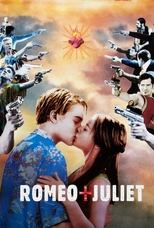
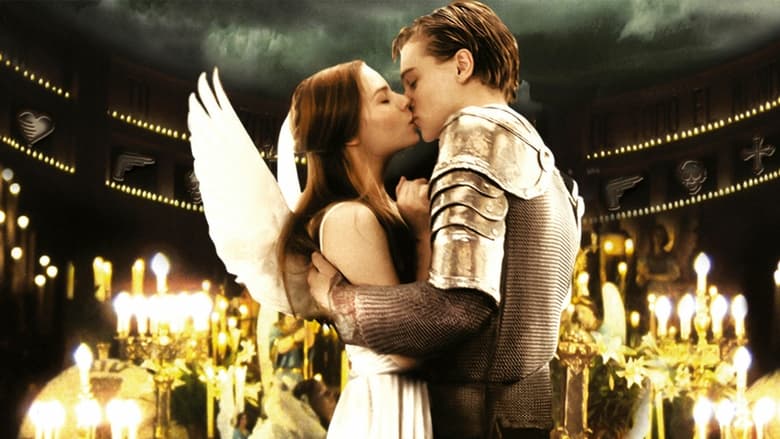
Baz Luhrmann’s William Shakespeare’s Romeo + Juliet is a fever dream of 1990s excess that pumps the Bard’s Elizabethan verse through the veins of a sun-scorched, hyper-violent Verona Beach. The film famously retains Shakespeare’s original dialogue but transposes the action to a fictional modern-day American city where swords are replaced by brand-name handguns and the feuding Montagues and Capulets are reimagined as rival corporate crime families. This audacious stylistic choice, drenching the classic tragedy in neon, religious iconography, and a thunderous alt-rock soundtrack, created a singular cinematic experience that aimed to make the 400-year-old language feel immediate and dangerous to a generation raised on MTV.
Luhrmann’s adaptation is a masterclass in visual storytelling that often communicates the play’s themes more vividly than the text alone. The characters are introduced like players in a spaghetti western, complete with rapid-fire zooms and title cards. Friar Laurence becomes a tattooed herbalist, Mercutio a drag-queen disco king, and the famous balcony scene unfolds in a shimmering swimming pool, trading a moonlit orchard for the electric blue glow of underwater desire. These changes are not merely cosmetic; they amplify the story’s core tensions—the reckless impulsivity of youth, the oppressive heat of a society on the brink, and the intoxicating, almost religious fervor of first love, embodied by Leonardo DiCaprio and Claire Danes’s luminous, heart-achingly sincere performances.
The film was a cultural phenomenon that divided purists but electrified a new audience, proving that Shakespeare’s work could be not just accessible but wildly entertaining without dumbing it down. Its reception was largely positive, with critics praising its bold vision and the palpable chemistry between its young stars, though some found the frenetic editing and relentless style overwhelming. DiCaprio’s portrayal of Romeo, in particular, cemented his status as a generational heartthrob and serious actor, earning him the Silver Bear for Best Actor at the Berlin International Film Festival. The film’s aesthetic became instantly iconic, influencing fashion, music videos, and teen culture for years to come.
Beyond its box office success, grossing over $147 million on a modest budget, the film’s legacy endures as a definitive 90s artifact and a gateway drug to Shakespeare for countless teenagers. It was recognized by the British Film Institute as one of the “50 films you should watch by the age of 14,” a testament to its unique ability to bridge the gap between high art and pop culture. By treating the source material not as a sacred text to be preserved in amber but as a living, breathing blueprint for a modern myth, Luhrmann’s Romeo + Juliet remains a landmark adaptation, as romantic and tragic as the play itself, but filtered through a lens of gun smoke, glitter, and gasoline.

Romeo and Juliet is a tragedy written by William Shakespeare early in his career, believed to have been composed between 1591 and 1595. It tells the story of two young star-crossed lovers whose deaths ultimately reconcile their feuding families in the Italian city of Verona. The play is among Shakespeare's most popular works and, alongside Hamlet, remains one of his most frequently performed plays.
The plot draws on a long tradition of tragic romances stretching back to antiquity. Shakespeare's immediate sources were Arthur Brooke's 1562 narrative poem The Tragical History of Romeus and Juliet and William Painter's 1567 prose version in Palace of Pleasure, both of which derived from an Italian tale by Matteo Bandello. Shakespeare expanded the story significantly, developing supporting characters like Mercutio and Paris, and employing a sophisticated poetic structure that shifts between comedy and tragedy.
The play was first published in a quarto edition in 1597, though this early text was of poor quality. A more authoritative version appeared in the 1599 quarto. The title characters have since become the archetypal young lovers in Western culture, and the play has inspired countless adaptations across opera, ballet, musical theatre, film, and television.