🎬 West Side Story (1961)
Based on play/musical
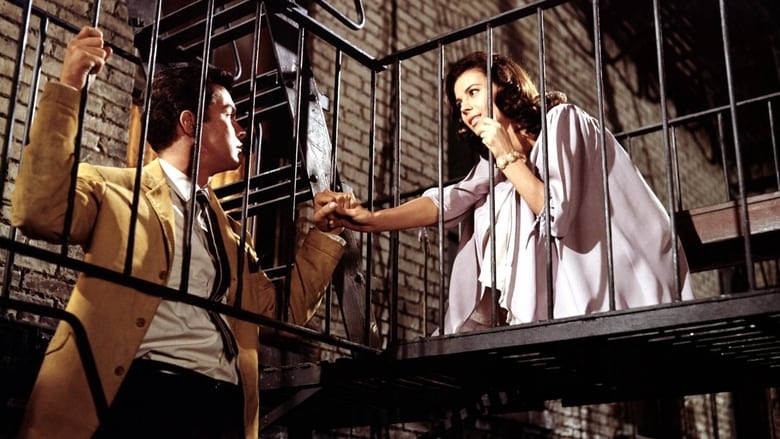
The 1961 film adaptation of West Side Story is a landmark in cinema history, a rare instance where a groundbreaking stage work was not just preserved but reimagined for the screen with electrifying results. Co-directed by Robert Wise and the musical's original director-choreographer Jerome Robbins, the film boldly opens up the claustrophobic stage setting, taking the Jets and Sharks from the confines of a theater to the actual, gritty streets of a New York City that was, at the time, undergoing massive urban renewal. The opening aerial shots of Manhattan, leading down to the playgrounds and tenements, immediately establish a sense of scale and realism that the stage could only suggest. Robbins' choreography, however, remains the film's beating heart, translating his balletic street-fighting into a dynamic cinematic language through Daniel L. Fapp's Oscar-winning cinematography.
The adaptation made several key changes from the 1957 Broadway production, most notably in the order of songs and the handling of the lyrics. The comedic number "Gee, Officer Krupke" was moved to precede the rumble, a structural shift that sharpens the dramatic irony before the fatal violence. More controversially, the film toned down some of Stephen Sondheim's more biting lyrics for the song "America" to avoid offending audiences, a decision Sondheim later regretted. The most significant behind-the-scenes choice, however, was the dubbing of the lead actors. While Rita Moreno and George Chakiris performed their own vocals, Natalie Wood's singing was dubbed by Marni Nixon, a fact kept secret from Wood during production, and Richard Beymer's voice was replaced by Jimmy Bryant. This practice, common at the time, created a slight disconnect between performance and voice, though Wood's luminous screen presence remains iconic.
The film was a colossal success, becoming the highest-grossing film of 1961 and winning a record-breaking 10 Academy Awards, including Best Picture, Best Director, and supporting acting honors for both Rita Moreno and George Chakiris. Its victory cemented the musical as a serious cinematic art form capable of tackling social issues like racism and juvenile delinquency. The vibrant color palette, the seamless blend of dance and drama, and the tragic power of its Romeo and Juliet-inspired narrative resonated deeply with audiences. Its legacy was further secured in 1997 when it was selected for preservation in the National Film Registry, a testament to its enduring cultural, historical, and aesthetic significance as one of the greatest musical films ever made.
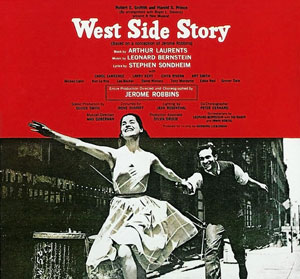
West Side Story is a landmark American musical conceived by Jerome Robbins, with music by Leonard Bernstein, lyrics by Stephen Sondheim, and a book by Arthur Laurents. It was inspired by William Shakespeare's tragedy Romeo and Juliet, transposing the story of star-crossed lovers to the turbulent streets of 1950s New York City. The narrative centers on the rivalry between two teenage street gangs, the white Jets and the Puerto Rican Sharks, and the doomed romance that blossoms between Tony, a former Jet, and Maria, the sister of the Sharks' leader.
The original Broadway production opened at the Winter Garden Theatre on September 26, 1957, and ran for 732 performances. Directed and choreographed by Jerome Robbins, it was a groundbreaking work that integrated dance, music, and dramatic storytelling in unprecedented ways. The show marked Stephen Sondheim's Broadway debut as a lyricist and introduced a darker, more socially conscious tone to the American musical theater canon.
West Side Story was nominated for six Tony Awards in 1958, winning two. Its sophisticated score, extended dance sequences, and unflinching exploration of prejudice, violence, and urban decay marked a turning point in musical theater history. The production subsequently enjoyed a successful West End run and numerous international productions, cementing its place as one of the most influential musicals ever created.

Romeo and Juliet is a tragedy written by William Shakespeare early in his career, believed to have been composed between 1591 and 1595. It tells the story of two young star-crossed lovers whose deaths ultimately reconcile their feuding families in the Italian city of Verona. The play is among Shakespeare's most popular works and, alongside Hamlet, remains one of his most frequently performed plays.
The plot draws on a long tradition of tragic romances stretching back to antiquity. Shakespeare's immediate sources were Arthur Brooke's 1562 narrative poem The Tragical History of Romeus and Juliet and William Painter's 1567 prose version in Palace of Pleasure, both of which derived from an Italian tale by Matteo Bandello. Shakespeare expanded the story significantly, developing supporting characters like Mercutio and Paris, and employing a sophisticated poetic structure that shifts between comedy and tragedy.
The play was first published in a quarto edition in 1597, though this early text was of poor quality. A more authoritative version appeared in the 1599 quarto. The title characters have since become the archetypal young lovers in Western culture, and the play has inspired countless adaptations across opera, ballet, musical theatre, film, and television.