🎬 Pokémon: The Rise of Darkrai (2007)
Part of Pokémon
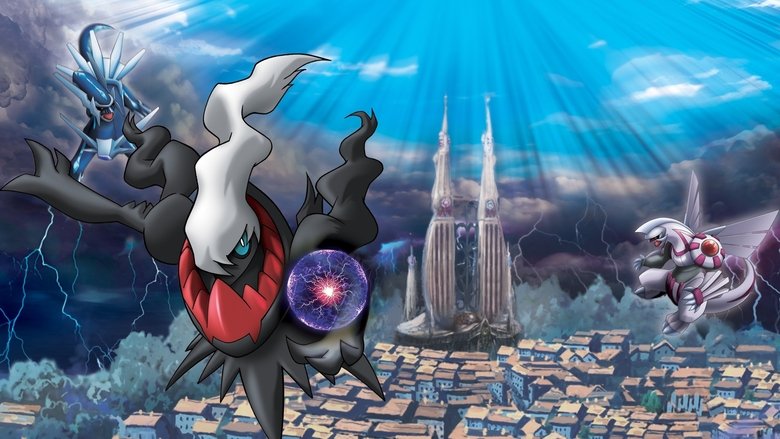
Pokémon: The Rise of Darkrai marked a significant tonal shift for the anime film series, serving as the cinematic debut of the Sinnoh era. Rather than a straightforward adaptation of the Diamond and Pearl games' plot involving Team Galactic, the film instead plucked the legendary Pokémon from the Sinnoh creation myth and thrust them into a high-stakes, reality-bending conflict. The story centers on the spatial warping caused when Dialga and Palkia, deities of time and space, collide in a dimension adjacent to the serene Alamos Town. The narrative cleverly inverts expectations by positioning the nightmare-inducing Darkrai not as the villain the townsfolk believe it to be, but as a misunderstood guardian desperately trying to save the town from being erased from existence.
The film takes considerable creative liberties with the source material's lore. While the games present Dialga and Palkia as cosmic forces kept strictly separate, the movie imagines the catastrophic consequences of their meeting, visualizing their battle as a surreal, cubist nightmare where the town's geography folds in on itself. The inclusion of the Space-Time Towers and the musical score "Oración" are original creations for the film, providing a deeply emotional, non-violent resolution to the god-like conflict. This emphasis on music as a pacifying force was a unique narrative device for the franchise, elevating the climax beyond a typical battle sequence and giving the film a distinct, almost operatic quality.
Upon its Japanese release in July 2007, the film received a mixed critical reception, with some praising its darker, more atmospheric tone and ambitious visual sequences, while others found the plot convoluted. Audiences, however, responded more warmly, appreciating the tragic nobility of Darkrai and the high-concept stakes. The film is particularly remembered for its haunting theme song, "Be With You (Itsumo Soba ni)," performed by Sarah Brightman, which lent the ending a sweeping, melancholic grace. It successfully launched the Diamond & Pearl film trilogy, establishing a connected narrative arc that would continue through the introduction of Giratina and Arceus in subsequent films, exploring the deeper mythology only hinted at in the original Nintendo DS games.

Pokémon Diamond Version and Pokémon Pearl Version are role-playing video games developed by Game Freak and published by The Pokémon Company and Nintendo for the Nintendo DS. Released in Japan in 2006 and internationally in 2007, they mark the beginning of the fourth generation of the Pokémon video game series. Set in the Sinnoh region, the games follow a young Pokémon Trainer on a journey to become the Champion while thwarting the schemes of Team Galactic, a criminal organization seeking to reshape the universe using the legendary Pokémon Dialga or Palkia.
The games introduced 107 new Pokémon, bringing the total to 493, and added significant new features including online play via the Nintendo Wi-Fi Connection, 3D-rendered environments, and changes to battle mechanics such as the physical/special split for moves. The day-night cycle returned with expanded time periods, and Pokémon Contests were revamped into Super Contests with new rhythm and dancing elements.
Diamond and Pearl were critically and commercially successful, selling over 17 million copies worldwide and revitalizing interest in the franchise. A third version, Pokémon Platinum, was released in 2008 with expanded story elements and features. The games spawned a long-running anime series, multiple films, and eventually remakes in the form of Pokémon Brilliant Diamond and Shining Pearl for the Nintendo Switch in 2021, as well as a prequel, Pokémon Legends: Arceus, in 2022.

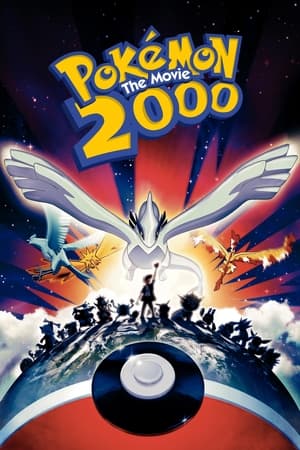
The Pokémon film collection is a long-running series of animated features that extends the adventures of the globally beloved Pokémon anime. Originating alongside the television series in the late 1990s, the films initially served as companion pieces to the ongoing narrative, following Ash Ketchum and his Pikachu as they encountered rare and legendary Pokémon in cinematic, self-contained stories. The early entries, beginning with 'Pokémon: The First Movie' in 1998, captured the peak of the late-90s Pokémon phenomenon and became a staple of the franchise's multimedia expansion, often distributed internationally by Warner Bros. during the anime's original broadcast run.
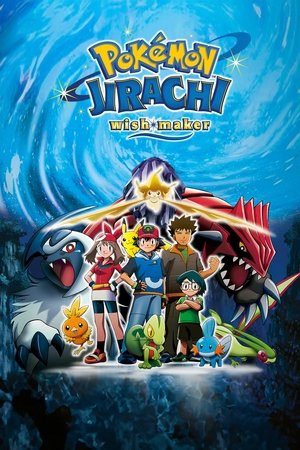
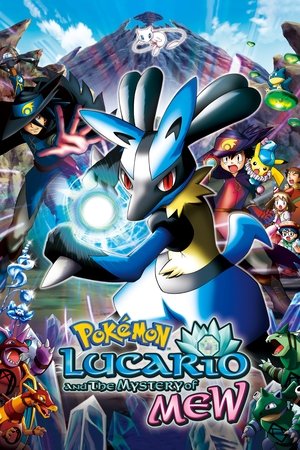
Over the decades, the collection evolved in tandem with the video game generations, with each film typically showcasing the mythical or legendary Pokémon introduced in the corresponding game release. This structure allowed the movies to function as both standalone adventures and promotional showcases for new creatures, while maintaining a consistent focus on themes of friendship, coexistence between humans and Pokémon, and the wonder of discovery. As the anime's continuity progressed through regions like Johto, Hoenn, Sinnoh, and beyond, the films mirrored these settings and introduced a rotating cast of supporting characters alongside the perennial heroes.
A significant shift occurred in the late 2010s when the film series began to depart from the main anime timeline. Starting with 'Pokémon the Movie: I Choose You!' in 2017, the collection embraced a reboot approach, retelling and reimagining Ash's origin story in an alternate continuity. This creative direction continued with subsequent entries, including a CGI remake of the first film, allowing the collection to explore nostalgic narratives while appealing to both new audiences and longtime fans. This period marked a transition from being direct extensions of the TV series to more experimental, standalone cinematic experiences.
The Pokémon film collection stands as a testament to the franchise's enduring cross-media legacy. With over two dozen theatrical releases spanning more than two decades, it has consistently delivered family-friendly adventures that reinforce the core values of the Pokémon world. While individual entries vary in critical reception, the collection as a whole remains a culturally significant component of one of the most successful entertainment properties in history, offering a cinematic entry point for each new generation of trainers.

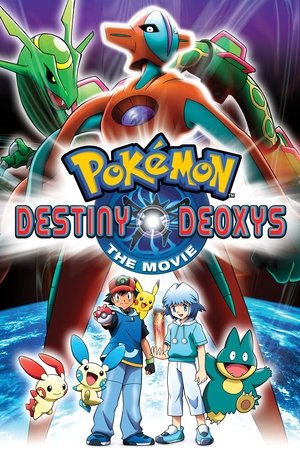
The Pokémon: Diamond and Pearl film series is a collection of animated features set within the broader Pokémon anime continuity, corresponding to the tenth through thirteenth seasons of the television series. These films follow the adventures of Ash Ketchum and his companions as they travel through the Sinnoh region, encountering legendary Pokémon whose powers often threaten the balance between dimensions, time, and space. The stories are deeply rooted in the mythology introduced in the fourth generation of Pokémon video games, exploring the origins of the Pokémon universe itself.
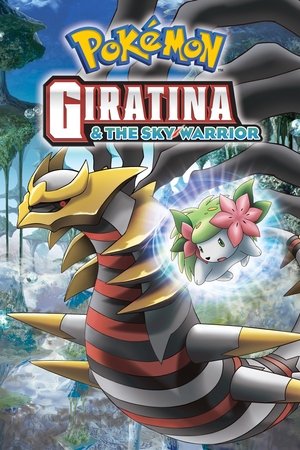
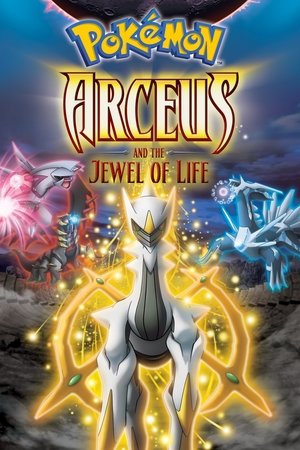
Each installment in this collection centers on a confrontation with a powerful, mythic Pokémon, beginning with the temporal and spatial disturbances caused by Dialga and Palkia. The narrative expands to include the Reverse World and its guardian, Giratina, before culminating in a direct encounter with Arceus, the Pokémon said to have created the Sinnoh region and possibly the entire Pokémon world. The final entry shifts focus to a more terrestrial conflict involving the shape-shifting Zoroark, while still maintaining ties to the legendary beasts of the Johto region.
These films are noted for their escalating stakes and interconnected storylines, a departure from the more standalone nature of earlier Pokémon movies. The trilogy of films centered on Dialga, Palkia, Giratina, and Arceus forms a continuous arc, with events from one film directly impacting the next. This serialized approach allowed for a deeper exploration of the Pokémon world's lore and provided a grand, cinematic scale to Ash's Sinnoh journey.
The Diamond and Pearl series represents a high point in the Pokémon anime's cinematic output, praised for its ambitious storytelling, fluid animation, and the emotional weight given to its legendary creatures. It successfully translated the complex mythology of the Sinnoh region games into a compelling narrative about coexistence, the consequences of disrupting nature's order, and the enduring bond between humans and Pokémon.