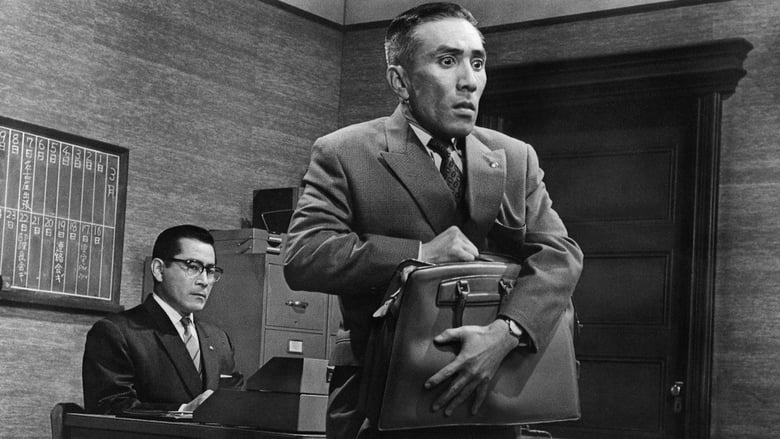
🎬 The Bad Sleep Well (1960)
Based on play/musical
Akira Kurosawa’s 1960 film The Bad Sleep Well is a masterful transposition of Shakespeare’s Hamlet from the royal courts of Elsinore to the gleaming, corrupt corridors of postwar corporate Japan. Rather than a literal adaptation, Kurosawa uses the play’s skeleton of grief, revenge, and moral paralysis to construct a searing neo-noir critique of institutional evil. The prince is reimagined as Koichi Nishi, played with simmering intensity by Toshiro Mifune, a young executive who marries into the family of the man responsible for his father’s death. The famous wedding banquet that opens the film serves as a modern-day equivalent of the play-within-a-play, a meticulously staged public spectacle where Nishi begins to tighten the net around his unsuspecting prey, all while the press watches like a cynical Greek chorus.
The film’s most radical departure from Shakespeare is its tone and ultimate trajectory. Where Hamlet wrestles with existential doubt through soliloquies, Nishi’s interior torment is expressed through action and a chillingly methodical facade. Kurosawa strips away the supernatural entirely—there is no ghost, only the lingering, unspoken memory of a father driven to suicide by the machinations of powerful men. The corruption is systemic rather than familial, with the villainous Vice President Iwabuchi standing in for Claudius as the head of a cabal that includes bureaucratic underlings mirroring Rosencrantz and Guildenstern. Ophelia becomes Yoshiko, a disabled and gentle woman who is both a pawn and, unexpectedly, the film’s moral center, her innocence and eventual breakdown providing the tragedy’s most devastating emotional blow.
Kurosawa also inverts the revenge narrative’s expected catharsis. The film’s title, a cynical proverb suggesting the wicked prosper, proves bitterly true. Nishi’s elaborate scheme unravels not through hesitation but through the sheer, unassailable power of the corporate structure he seeks to dismantle. The climax, set in a rubble-strewn industrial wasteland, replaces the elegant duel of the source material with a brutal, anonymous, and ultimately futile confrontation. This was Kurosawa’s first independent production, and its unflinching portrayal of corporate malfeasance resonated deeply in a Japan still reckoning with its economic reconstruction. The film was entered into the 11th Berlin International Film Festival, cementing Kurosawa’s international stature as a director capable of transforming classic literature into urgent, contemporary cinema.

The Tragedy of Hamlet, Prince of Denmark is a tragedy by William Shakespeare, believed to have been written between 1599 and 1601. Set in Denmark, the play follows Prince Hamlet as he seeks revenge against his uncle Claudius, who murdered Hamlet's father to seize the throne and marry Hamlet's mother, Gertrude. The play explores themes of madness, revenge, mortality, and corruption, and features some of the most famous soliloquies in the English language, including "To be, or not to be."
The play exists in three early versions: the First Quarto (1603), the Second Quarto (1604), and the First Folio (1623), each containing lines and scenes missing from the others. Shakespeare drew on a variety of sources, including the legendary Danish prince Amleth from Saxo Grammaticus's 12th-century history and earlier Elizabethan revenge tragedies. Hamlet is Shakespeare's longest play and the title role is one of the most demanding and sought-after in theatre.
Hamlet is widely regarded as one of the most powerful and influential works in world literature. It has been performed countless times on stage and adapted into numerous films, operas, ballets, and novels. The character of Hamlet, with his philosophical introspection and existential doubt, has become an archetype of the modern consciousness, and the play's exploration of grief, betrayal, and the nature of action continues to resonate across cultures and centuries.