🎬 Hamlet (1948)
Based on play/musical
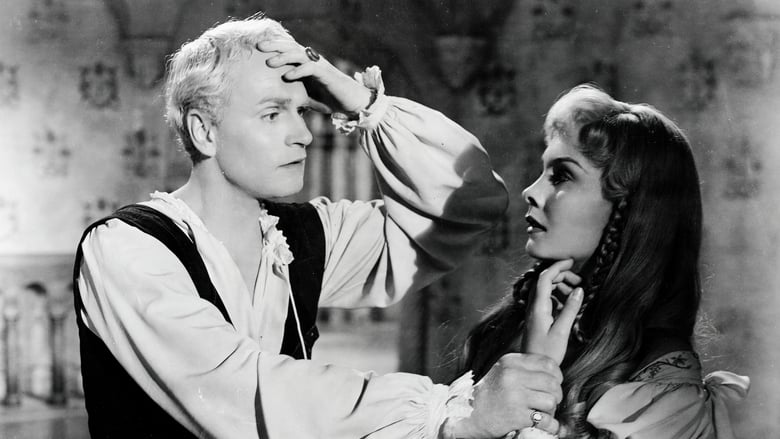
Laurence Olivier’s 1948 adaptation of Hamlet stands as a landmark in Shakespearean cinema, not least for being the first British film to ever win the Academy Award for Best Picture. Olivier, who directed, produced, and starred in the title role, crafted a deeply psychological and visually atmospheric interpretation that was as much a personal artistic statement as it was a faithful rendering of the play. Shot in stark, expressionistic black-and-white, the film uses the labyrinthine sets of Elsinore to mirror the prince’s fractured psyche, famously describing it as the story of "a man who could not make up his mind." This Freudian lens, which foregrounds an Oedipal reading of Hamlet’s relationship with his mother Gertrude, was a bold and controversial choice that distinguished the film from traditional stage productions.
The adaptation is notorious among purists for its radical textual excisions. Olivier cut over an hour and a half from Shakespeare’s longest play, eliminating entire characters such as Rosencrantz, Guildenstern, and Fortinbras. These cuts fundamentally altered the play’s political and comic dimensions, stripping away the subplot of the Norwegian threat and the sardonic wit of Hamlet’s university friends to focus almost exclusively on the prince’s internal torment. While critics like Milton Shulman acknowledged Olivier’s towering performance, they lamented these liberties, arguing that the film sacrificed the play’s rich tapestry for a streamlined, albeit powerful, character study. The decision to open with a voiceover declaring the tragedy of a man who could not decide further signaled Olivier’s intent to prioritize psychological drama over textual fidelity.
Despite the scholarly controversy, the film was a monumental critical and commercial success, securing Olivier the Academy Award for Best Actor and the Golden Lion at the Venice Film Festival. It became the definitive cinematic Hamlet for a generation, setting a benchmark for how Shakespeare could be translated to the screen. Olivier’s athletic and intense performance, combined with the haunting deep-focus cinematography, created an enduring image of the melancholy Dane. The film’s legacy is that of a masterful, if highly personal, interpretation that proved Shakespeare could be not just prestigious but also profoundly cinematic, even if it meant reshaping the source material to fit a singular directorial vision.

The Tragedy of Hamlet, Prince of Denmark is a tragedy by William Shakespeare, believed to have been written between 1599 and 1601. Set in Denmark, the play follows Prince Hamlet as he seeks revenge against his uncle Claudius, who murdered Hamlet's father to seize the throne and marry Hamlet's mother, Gertrude. The play explores themes of madness, revenge, mortality, and corruption, and features some of the most famous soliloquies in the English language, including "To be, or not to be."
The play exists in three early versions: the First Quarto (1603), the Second Quarto (1604), and the First Folio (1623), each containing lines and scenes missing from the others. Shakespeare drew on a variety of sources, including the legendary Danish prince Amleth from Saxo Grammaticus's 12th-century history and earlier Elizabethan revenge tragedies. Hamlet is Shakespeare's longest play and the title role is one of the most demanding and sought-after in theatre.
Hamlet is widely regarded as one of the most powerful and influential works in world literature. It has been performed countless times on stage and adapted into numerous films, operas, ballets, and novels. The character of Hamlet, with his philosophical introspection and existential doubt, has become an archetype of the modern consciousness, and the play's exploration of grief, betrayal, and the nature of action continues to resonate across cultures and centuries.