🎬 The Three Musketeers: D'Artagnan (2023)
Part of The Three Musketeers
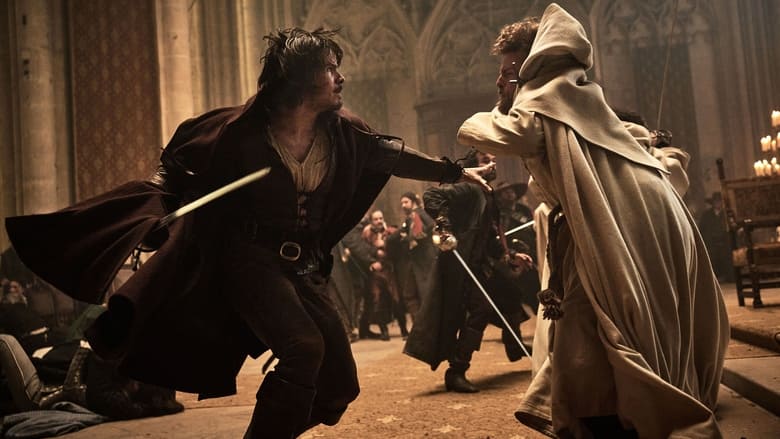
Martin Bourboulon’s 2023 epic, The Three Musketeers: D’Artagnan, arrives as a muscular, grounded, and refreshingly gritty reinterpretation of Alexandre Dumas’s classic, stripping away much of the campy flamboyance that characterized many previous film versions. Shot back-to-back with its sequel Milady on a massive €72 million budget, this first installment treats the source material not as a light-hearted swashbuckler but as a tense, muddy, and politically charged thriller. The film’s most immediate innovation is its visual and tonal texture: shot largely with natural light and handheld cameras, it plunges the viewer into a 17th-century France that feels tactile and dangerous, where sword fights are messy, exhausting affairs rather than balletic displays. This approach re-grounds the legendary camaraderie of the four heroes in a world of real stakes, making their famous motto feel less like a jaunty catchphrase and more like a necessary survival pact in a kingdom riddled with spies and religious conflict.
The screenplay, by Matthieu Delaporte and Alexandre de La Patellière, makes several key structural changes to Dumas’s sprawling narrative, most notably by centering the conspiracy around a stolen necklace and elevating the threat of a looming religious war between Catholics and Protestants. This gives the film a cohesive, propulsive plot spine that the more episodic novel sometimes lacks. The casting is a major part of the adaptation’s success: François Civil plays D’Artagnan as a hot-headed, almost feral youth whose bravery is indistinguishable from recklessness, while Vincent Cassel’s Athos is a brooding, self-destructive figure haunted by a past that the film teases out more explicitly than the book does in its early chapters. Eva Green’s Milady de Winter is a particular triumph—a cunning, multilingual operative whose lethal skills are showcased in action sequences the novel never provided, transforming her from a purely seductive antagonist into a physically formidable spy who is every bit the musketeers’ equal in combat.
Critically, the film was embraced as a triumphant return to form for large-scale French historical cinema, earning six César Award nominations and becoming one of the year’s highest-grossing domestic productions with over 3.4 million tickets sold in France. International audiences also responded, drawn by a cast with global recognition and a visual style that echoes the prestige historical dramas of Ridley Scott. The decision to split the novel into a two-part saga allows D’Artagnan to breathe, ending on a cliffhanger that sets the stage for the siege of La Rochelle and Milady’s revenge. This structural choice means the film can linger on character moments—such as D’Artagnan’s separate duels with Athos, Porthos, and Aramis, staged here as a single, fluid, and darkly comedic sequence in a rain-soaked alley—that other adaptations rush through to get to the action.
What distinguishes this adaptation is its commitment to historical verisimilitude without sacrificing the story’s romantic soul. The musketeers’ loyalty is tested not just by external enemies but by internal fractures, particularly Athos’s traumatic connection to Milady, which the film handles with a psychological depth rare in Dumas adaptations. By the time the credits roll, D’Artagnan has successfully repositioned a tale often dismissed as juvenile adventure into a rich, adult drama of political machination and personal demons, proving that even the most familiar stories can feel newly urgent when told with conviction and a willingness to get a little mud on their boots.
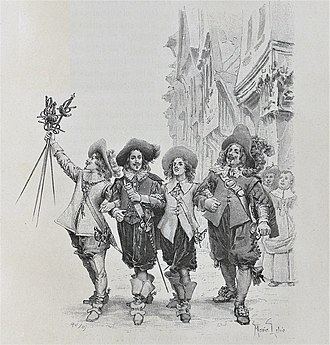
The Three Musketeers is a historical adventure novel written by French author Alexandre Dumas, first published in serial form in 1844. Set between 1625 and 1628, it recounts the adventures of a young man named d'Artagnan after he leaves home to travel to Paris, hoping to join the Musketeers of the Guard. Although d'Artagnan is not able to join this elite corps immediately, he befriends three of the most formidable musketeers of the age — Athos, Porthos, and Aramis — and becomes embroiled in affairs of state and court.
The novel is celebrated for its swashbuckling action, memorable characters, and intricate plotting involving political intrigue, romance, and betrayal. It explores themes of honor, friendship, and loyalty, famously encapsulated in the musketeers' motto: "All for one, and one for all." The story draws loosely on historical figures and events, including Cardinal Richelieu, King Louis XIII, Queen Anne, and the Duke of Buckingham.
One of the most widely read French novels, The Three Musketeers has been adapted countless times across virtually every medium, including film, television, stage, and comics. Its enduring popularity has made d'Artagnan and the three musketeers archetypal figures in popular culture, and the novel remains a cornerstone of classic adventure literature.

Based on Alexandre Dumas's 1844 historical adventure novel, this enduring saga originated as a serialized publication in France before being compiled into book form. The story draws inspiration from 17th-century French history and the memoirs of real-life soldier Charles de Batz-Castelmore d'Artagnan, skillfully blending factual events with romanticized fiction to create a timeless narrative.
Set against the backdrop of the reign of Louis XIII and the political machinations of Cardinal Richelieu, the saga explores themes of loyalty, honor, and unwavering camaraderie. It follows the exploits of elite royal guards known as the Musketeers of the Guard, who navigate court intrigue, dangerous duels, and national crises while upholding a famous creed of unity and mutual defense.
The narrative has become a cornerstone of French cultural identity, often described as a national touchstone that has captivated generations. Its enduring popularity has inspired countless adaptations across literature, theater, and cinema, cementing its status as a classic swashbuckler that continues to resonate with audiences through its blend of historical drama, heroic adventure, and timeless moral lessons.