🎬 Oliver Twist (1948)
Based on novel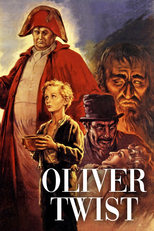
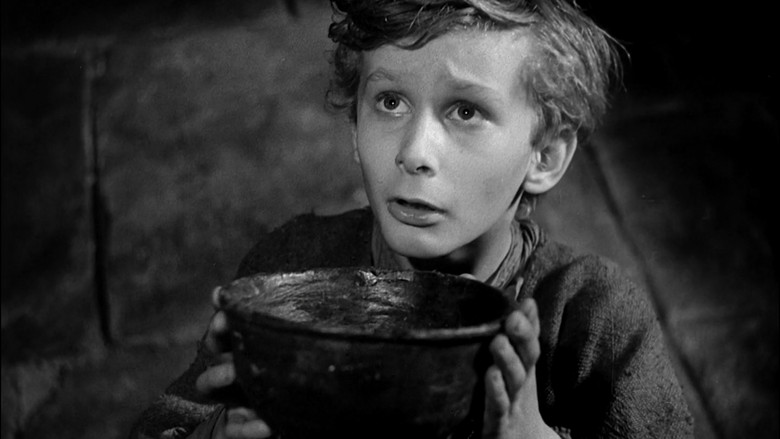
David Lean’s 1948 adaptation of Oliver Twist stands as a masterclass in translating Dickensian atmosphere to the screen, arriving just two years after his acclaimed Great Expectations. Lean reassembled his core creative team, including cinematographer Guy Green and designer John Bryan, to craft a London that feels both mythic and oppressively real. The film is drenched in expressionistic shadows and skewed angles, transforming the city into a labyrinth of menace perfectly suited to the story of a vulnerable orphan navigating a world of adult cruelty. While the novel sprawls across serialized adventures, Lean’s screenplay ruthlessly streamlines the plot, excising entire subplots like the Maylie family’s extended country idyll to maintain a relentless narrative drive toward Oliver’s ultimate salvation.
At the heart of the film is Alec Guinness’s controversial and mesmerizing performance as Fagin. Under heavy prosthetic makeup—a hooked nose and wild beard that sparked accusations of antisemitic stereotyping upon the film’s release, leading to cuts and delayed distribution in the United States and a ban in Israel—Guinness creates a character of twitchy, avaricious energy. His Fagin is less the comic grotesque of earlier illustrations and more a tragic figure trapped in his own den of iniquity. Opposite him, Robert Newton’s Bill Sikes is a volcanic force of brute violence, while Kay Walsh, Lean’s wife and script collaborator, brings a raw, desperate humanity to Nancy, making her ultimate betrayal and brutal murder one of the most harrowing sequences in classic British cinema. The murder scene, staged with shocking intensity for its era, uses shadow and sound to suggest violence far beyond what the Production Code would normally allow.
Lean’s adaptation makes a crucial structural change by opening with Oliver’s mother staggering through a storm to the workhouse, a sequence entirely of the filmmaker’s invention that immediately establishes the gothic, pitiless world the child is born into. The casting of John Howard Davies as Oliver was itself a form of adaptation; Lean chose him for a quality of passive, angelic endurance rather than the slightly more spirited boy of the novel, turning Oliver into a near-silent witness to the horrors around him. This choice, combined with Guy Green’s deep-focus photography that often frames Oliver as small and isolated within cavernous, decaying spaces, visually reinforces the novel’s social critique of institutional indifference. The British Film Institute has recognized the film’s enduring power, placing it 46th on its list of the top 100 British films and later naming it one of the 50 films to see by age 14, cementing its status as a definitive cinematic interpretation of Dickens.

Oliver Twist, or The Parish Boy's Progress, is the second novel by English author Charles Dickens. It was first published as a serial from 1837 to 1839 in the magazine Bentley's Miscellany, and then as a three-volume book in 1838. The novel tells the story of the orphan Oliver Twist, who endures a harsh upbringing in a workhouse, is sold into apprenticeship, and eventually escapes to London, where he becomes entangled with a gang of juvenile pickpockets led by the conniving Fagin. Through a series of adventures, Oliver discovers his true identity and finds a family.
The novel is an early example of the social novel, satirizing the cruel treatment of orphans, child labor, and the criminal underworld of 19th-century England. Dickens drew on his own difficult childhood experiences and the reported case of a child laborer to lend authenticity to Oliver's plight. The character of Fagin became one of Dickens's most memorable villainous creations, while Nancy's moral complexity added depth.
Oliver Twist has been highly influential in literature and popular culture, helping to raise awareness about social injustices. Its vivid characters and dramatic narrative have made it a favorite for stage and screen adaptations. The novel remains a staple of English literature, studied for its themes of poverty, class, and redemption.