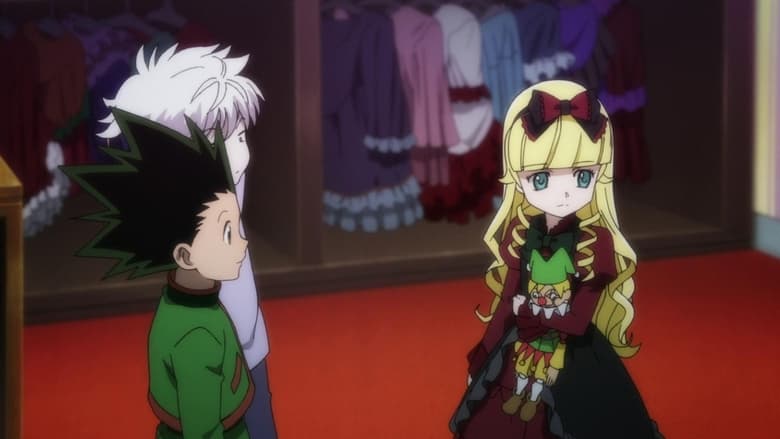
🎬 Hunter x Hunter: Phantom Rouge (2013)
Part of Hunter x Hunter
Hunter x Hunter: Phantom Rouge occupies a curious space in the franchise, serving as the first feature film for the 2011 anime reboot. Rather than crafting a completely original side-story, the film cleverly weaves its narrative around one of the series' most emotionally charged backstories: the massacre of the Kurta Clan. The script, which received input from original manga author Yoshihiro Togashi, introduces a previously unseen survivor from Kurapika's past, a childhood friend named Pairo, who becomes the central mystery. This approach allows the film to function as a character study for Kurapika, exploring the lingering trauma of his quest for vengeance against the Phantom Troupe, while still providing the high-stakes action expected of a theatrical release.
The film's antagonist, a former member of the Phantom Troupe with the ominous designation of Number 4, is a fascinating addition to the series' lore. This character, Omokage, was actually referenced in the original manga as the member Hisoka replaced by killing, but his appearance and abilities were never shown. Phantom Rouge brings this ghost to life, giving him a haunting Nen ability centered around puppetry and stolen eyes, which ties directly into the Kurta Clan's unique physiology. The movie also delves into the friendship between Gon and Killua, framing the adventure with a subplot about Killua's deep-seated fear of betrayal, a psychological wound inflicted by his brother Illumi that threatens to tear the duo apart.
Produced by Madhouse, the animation studio behind the celebrated 2011 series, Phantom Rouge maintains a high level of visual consistency with the show, ensuring that the characters and Nen battles feel authentic to the world fans had come to love. The film opened at number one at the Japanese box office in January 2013, a testament to the series' immense popularity during its broadcast run. While some critics noted that the film's pacing felt rushed compared to the methodical storytelling of the manga, it was generally well-received by fans for its emotional core and the rare opportunity to see Kurapika take center stage in a narrative that directly confronts his past.
For international audiences, the wait was considerable. Viz Media eventually brought the film to North America on home video in February 2018, years after the main series had concluded its run. This release allowed English-speaking fans to complete their collection and experience a story that, while not strictly canon, is enriched by Togashi's involvement and provides a satisfying, bittersweet epilogue of sorts to the Yorknew City arc's lingering threads. It remains a compelling watch for those invested in the tragic fate of the Kurta and the unbreakable, yet tested, bond between Gon and Killua.

Hunter × Hunter is a Japanese manga series written and illustrated by Yoshihiro Togashi. It began serialization in Shueisha's Weekly Shōnen Jump magazine in March 1998 and has been collected into numerous tankōbon volumes. The story follows Gon Freecss, a young boy who discovers his supposedly dead father is actually a legendary Hunter, an elite member of humanity licensed to track down secret treasures, rare beasts, or even other individuals. Gon sets out to pass the grueling Hunter Examination and find his father, making friends and facing increasingly dangerous threats along the way.
Togashi's work is renowned for its intricate power system called Nen, complex character arcs, and a narrative that frequently subverts shōnen genre conventions. The manga has experienced several extended hiatuses due to the author's health, which has only added to its legendary status among fans. Despite this, it remains one of Weekly Shōnen Jump's best-selling series, with over 84 million copies in circulation worldwide.

The *Hunter x Hunter* collection encompasses the animated film extensions of Yoshihiro Togashi's acclaimed manga and its 2011 anime adaptation. Originating from a series celebrated for its intricate Nen power system and morally complex storytelling, these cinematic entries serve as companion pieces that deepen the lore of the central characters while delivering the high-stakes action the series is known for. The collection includes *Phantom Rouge* and *The Last Mission*, both released in 2013, which explore untold facets of the Hunters Association and the personal vendettas that drive its heroes.
*Phantom Rouge* functions as a poignant, character-driven prelude that revisits Kurapika's traumatic past and his relentless vendetta against the Phantom Troupe. It weaves a narrative about the corrosive nature of revenge and the power of recovered memory, visualizing a story only briefly touched upon in the main series. In contrast, *The Last Mission* propels the story into an original, high-octane conflict that reveals a dark schism within the Hunters Association, born from a battle between "On" and the sacred Nen. This film escalates the series' signature themes of corruption and institutional decay, pitting Gon and Killua's determination against a vengeful phantom of the past.
Together, these entries showcase the remarkable versatility of *Hunter x Hunter*, a collection that can seamlessly oscillate between intimate tragedy and explosive ideological warfare. While the films are self-contained narratives, they maintain an unwavering focus on the psychological depth and tactical combat that have cemented the series as a landmark of the shōnen genre. The collection enriches the broader *Hunter x Hunter* world, offering fans deeper insight into its characters and the shadowy history of its institutions.