🎬 Iron Man: Rise of Technovore (2013)
Based on comic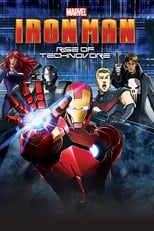
Madhouse's 2013 anime feature "Iron Man: Rise of Technovore" offers a distinctively Japanese reinterpretation of the Armored Avenger, trading the polished sheen of the Marvel Cinematic Universe for a grittier, more philosophical cyberpunk aesthetic. Directed by Hiroshi Hamasaki, known for the brutal samurai drama "Shigurui: Death Frenzy" and the dystopian "Texhnolyze," the film immediately establishes a different tone. It opens not with a boardroom quip, but with a high-speed desert ambush that leaves War Machine seemingly dead, propelling a vengeful Tony Stark into a shadowy conflict against a biotechnological threat. This adaptation leans heavily into the techno-organic horror that has occasionally surfaced in the comics, pitting Iron Man against a villain whose power is a dark mirror of Stark's own fusion of man and machine.
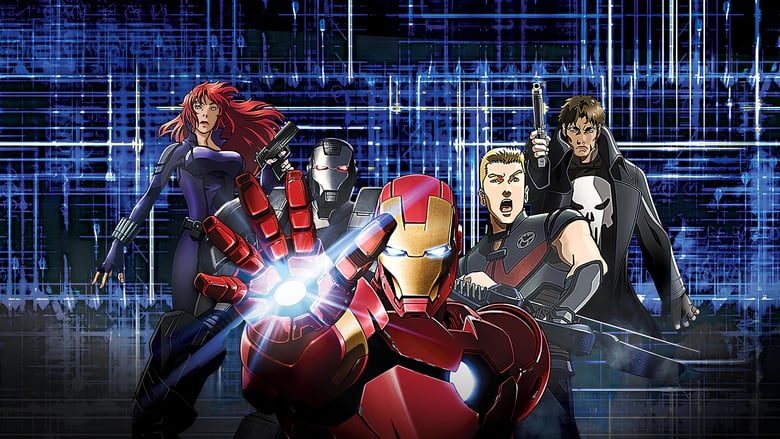
The film makes a bold narrative choice by positioning Ezekiel Stane, the son of Tony's classic nemesis Obadiah Stane, as its antagonist, though here he is reimagined as the mastermind behind the "Technovore" entity. This creates a generational conflict absent from the source material's original Silver Age tales, where Cold War industrialists were the primary foes. The adaptation also integrates the Punisher as a significant secondary character, voiced by Norman Reedus, who serves as a ruthless foil to Stark's guilt-driven mission. This pairing allows the story to explore the moral line between justice and vengeance, a theme amplified by the film's S.H.I.E.L.D. being portrayed as an obstructive, almost antagonistic force led by a hawkish Nick Fury, rather than a supportive ally.
Visually, "Rise of Technovore" is a departure from Western superhero animation, embracing Madhouse's signature style with fluid, high-octane action sequences and detailed mechanical designs that emphasize the raw power of the Iron Man armor. The narrative scope is global and apocalyptic, moving from the Utah salt flats to a S.H.I.E.L.D. helicarrier and a secret A.I.M. facility in Karachi, escalating the stakes far beyond a typical corporate sabotage plot. While the film is a standalone story, it exists within the broader continuity of the Marvel Anime universe, which gave it the freedom to reinterpret character dynamics and visual motifs without being beholden to the primary Earth-616 comic continuity or the then-burgeoning MCU.
Reception to this specific adaptation was mixed, with many Western fans finding the characterizations and narrative logic jarring compared to the more familiar portrayals. However, it stands as a fascinating cultural artifact—a genuine attempt to filter a quintessentially American capitalist hero through a Japanese lens, focusing on themes of technological hubris, bodily violation, and existential dread. It adapts the core of Iron Man—a genius burdened by the consequences of his creations—but expresses it through a moody, violent, and visually arresting anime vocabulary that makes it a unique entry in the character's extensive multimedia history.

Iron Man is a superhero appearing in American comic books published by Marvel Comics. The character was co-created by writer and editor Stan Lee, developed by scripter Larry Lieber, and designed by artists Don Heck and Jack Kirby, making his first appearance in Tales of Suspense #39 (cover-dated March 1963). The character's alter ego is Tony Stark, a wealthy American business magnate, playboy, philanthropic scientist, and ingenious engineer who suffers a severe chest injury during a kidnapping. When his captors attempt to force him to build a weapon of mass destruction, he instead creates a mechanized suit of armor to save his life and escape captivity. He later upgrades and refines the suit, using it to protect the world as Iron Man.
Throughout his publication history, Iron Man has been a foundational member of the superhero team the Avengers, with his own self-titled comic series running across multiple volumes since 1968. The character's stories have often explored themes of Cold War politics, technological ethics, corporate responsibility, and personal demons — most notably Stark's ongoing battle with alcoholism, which was dramatically portrayed in the landmark 1979 storyline 'Demon in a Bottle.'
Over the decades, Iron Man evolved from a B-list Marvel hero into one of the company's flagship characters. His rogues' gallery includes iconic villains such as the Mandarin, Titanium Man, Crimson Dynamo, and Obadiah Stane. The character's comic book legacy spans thousands of issues and has featured celebrated runs by creators including David Michelinie, Bob Layton, Dennis O'Neil, Warren Ellis, and Matt Fraction, each bringing new dimensions to Tony Stark's complex personality and moral struggles.