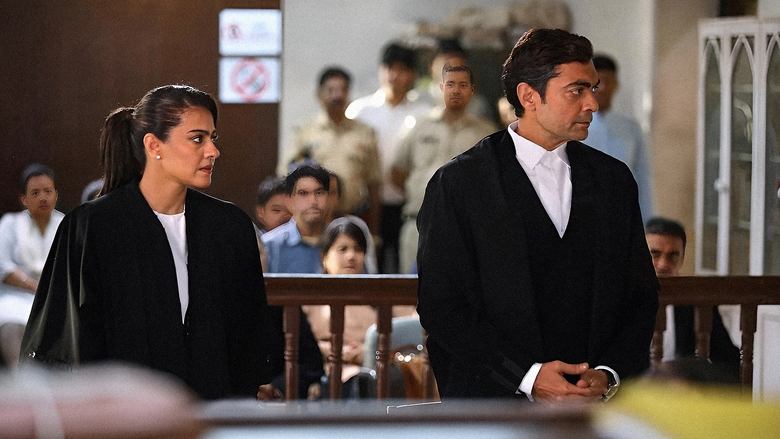
📺 The Trial (2023)
Part of The Good Wife Adaptations
The Trial: Pyaar Kaanoon Dhokha is a 2023 Indian Hindi-language legal drama series that serves as an official adaptation of the acclaimed American series The Good Wife. Created by Robert and Michelle King, the original show was a critical darling that ran on CBS from 2009 to 2016, starring Julianna Margulies as a disgraced politician's wife who resurrects her legal career. The Indian adaptation transplants this core premise to a new cultural context, with Bollywood superstar Kajol making her major streaming series debut in the lead role of Noyonika Sengupta.
The series follows Noyonika, a law school graduate who abandoned her career to raise her children, as she is forced back into the workforce when her husband, Rajeev, is arrested in a high-profile sex and corruption scandal. To support her family and reclaim her identity, she takes a junior lawyer position at a law firm, navigating the humiliation of her public scandal while proving her legal acumen. The show was released on Disney+ Hotstar on July 14, 2023, and was quickly renewed for a second season, which is scheduled for release on September 19, 2025.
As an adaptation, The Trial reimagines the characters and legal cases of The Good Wife for an Indian audience, translating the political and social dynamics of Chicago into the Indian judicial system. The series is part of a global franchise of Good Wife adaptations, which also includes the South Korean drama The Good Wife (2016) and the Japanese version of the same name (2019). While the original series was celebrated for its sophisticated, slow-burn storytelling over seven seasons, the Indian version condenses and re-contextualizes the narrative to fit a different episodic format and cultural sensibility, with Kajol's star power bringing a new dimension to the central role.

The Good Wife Adaptations form a remarkable global television phenomenon, demonstrating how a single narrative template can be reshaped by vastly different cultural and legal landscapes. Originating from the critically acclaimed American series created by Robert and Michelle King, the core premise follows a spouse forced to rebuild a legal career after their partner’s public scandal and incarceration. What makes this collection truly significant is not mere replication, but the act of cultural translation; each version filters the story through local attitudes toward gender, power, and justice, transforming a personal journey of betrayal into a universal examination of professional reinvention. From East Asia to South Asia, Europe, and the Middle East, the franchise reveals how the tension between domestic expectations and courtroom ambition resonates across borders.
The evolution of the narrative is striking in its diversity, with entries like South Korea’s *굿 와이프* and Japan’s *The Good Wife* adapting the procedural format to reflect their own judicial systems and social hierarchies, often intensifying the melodramatic and familial stakes. India’s *द ट्रायल: प्यार, क़ानून, धोखा* infuses the story with the specific textures of the country’s legal world and moral codes, while Russia’s *Хорошая жена* and China’s *玫瑰之战* recontextualize the protagonist’s struggle within their own rapidly changing societal norms. Even entries that deviate more loosely, such as the Irish drama *Striking Out*, which focuses on a woman starting her own firm after discovering infidelity, and the Arabic adaptation *مفترق طرق*, which navigates the story through a distinctly regional lens, contribute to a rich tapestry of reinterpretation. These series collectively prove that the courtroom is a perfect stage for exploring the personal, making the franchise a masterclass in how local specificity can heighten universal themes.
Beyond their entertainment value, The Good Wife Adaptations have left a lasting cultural impact by consistently placing complex female agency at the center of prime-time television. The collection charts a shift in global storytelling, moving away from simple victimhood toward nuanced portrayals of women navigating moral ambiguity, professional rivalry, and sexual politics. By seeing how different cultures negotiate the character’s relationship with her disgraced husband and her competitive workplace, audiences gain insight into the global conversation about marriage and independence. Ultimately, this franchise endures not because the plot is easily copied, but because the emotional core—a woman reclaiming her identity in the face of public humiliation—is a powerful, malleable myth that challenges and inspires, no matter the language in which it is told.