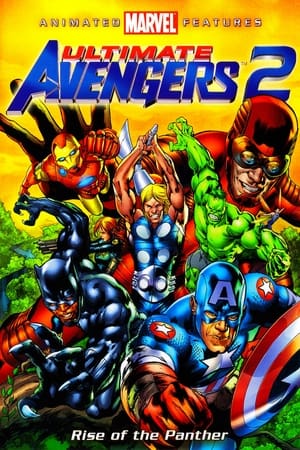
🎬 Ultimate Avengers: The Movie (2006)
Part of Ultimate Avengers
Released in 2006 as the inaugural entry in Marvel’s direct-to-video Animated Features line, "Ultimate Avengers: The Movie" was the first major screen adaptation to draw directly from Mark Millar and Bryan Hitch’s groundbreaking "The Ultimates" comic. Rather than a straightforward translation, the film acts as a streamlined fusion of the comic’s first volume and the classic Avengers origin myth. It borrows the Ultimate universe’s core premise—a government-sanctioned team assembled by Nick Fury to combat emerging superhuman threats—but compresses the narrative significantly to fit a 72-minute runtime. The alien invasion by the shape-shifting Chitauri replaces the comic’s more gradual, politically charged buildup, giving the newly formed team an immediate, world-ending crisis to unite against.
The character dynamics are simplified but retain the source material’s edgier tone. The film preserves the Ultimate line’s contentious relationship between a more arrogant, contemporary Bruce Banner and the rest of the team, leading directly to his jealous, destructive rampage as the Hulk—a set-piece that echoes the comic’s infamous Manhattan destruction sequence. Captain America’s man-out-of-time trauma is present, though softened for a broader audience, and the Wasp’s mutant origins are explicitly tied to Hank Pym’s experiments, a nod to the comic’s dysfunctional romance. Notably, Thor’s ambiguous nature—is he a god or a delusional super-soldier?—is largely dropped in favor of confirming his Asgardian heritage early on, losing some of the comic’s satirical edge.
Critically, the film was met with a mixed but intrigued reception. Many praised its fluid, widescreen action choreography, which successfully translated Hitch’s cinematic panel layouts into animation, and its willingness to deliver a harder PG-13 edge than previous Marvel cartoons. However, purists noted the loss of the comic’s dense political subtext and decompressed character work. The voice cast, featuring Justin Gross as a suitably square-jawed Steve Rogers, helped ground the fantastical elements. Its success as a brisk, action-oriented pilot proved Marvel Animation could handle more mature, serialized storytelling, directly paving the way for its sequel just months later and influencing the tone of future animated projects.

The Ultimates is a superhero comic book series published by Marvel Comics, created by writer Mark Millar and artist Bryan Hitch. It debuted in 2002 under Marvel's Ultimate imprint, which reimagined classic Marvel characters in a modern, more realistic setting. The series focuses on a government-sponsored team of superheroes assembled by Nick Fury to combat threats too large for conventional forces.
The team's core lineup includes updated versions of Captain America, Iron Man, Thor, Hulk, Wasp, and Giant-Man. The series is known for its widescreen cinematic style, decompressed storytelling, and a tone that blends superhero action with political thriller elements. It heavily influenced the visual and narrative direction of the Marvel Cinematic Universe, particularly the first Avengers film.
The Ultimates ran for two main volumes, with the first concluding in 2004. It was a critical and commercial success, praised for its mature take on superhero dynamics and its blockbuster-scale action sequences. The series remains one of the defining works of the Ultimate Marvel line and a landmark in modern superhero comics.
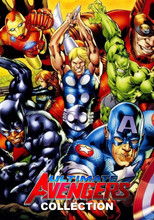
Ultimate Avengers is a direct-to-video animated duology produced by MLG Productions, a joint venture between Marvel Studios and Lions Gate Entertainment. The two films, released in 2006, are loosely based on the Ultimates comic book series by Mark Millar and Bryan Hitch, which reimagined the classic Avengers team in a modern, grittier context. They were the inaugural entries in the larger Marvel Animated Features line, a collection of eight animated superhero movies released between 2006 and 2011.
The duology presents an alternate version of the Marvel Universe where classic heroes like Captain America, Iron Man, Thor, and the Hulk are brought together by the espionage agency S.H.I.E.L.D. to combat threats too large for any single hero. The narrative draws heavily from the early 2000s comic book revival that sought to update these characters for a new generation, stripping away decades of convoluted continuity in favor of a streamlined, cinematic approach. Themes of teamwork, trust, and the burden of power are central to the story.
As the first entries in the Marvel Animated Features line, the Ultimate Avengers films helped establish a shared animated universe for Marvel's direct-to-video offerings. They arrived at a time when superhero animation was gaining significant traction, paving the way for more mature and serialized storytelling outside of Saturday morning cartoons. The films were noted for their action-oriented style and for introducing lesser-known characters to a wider audience.
This duology holds a notable place in Marvel's animation history as an early attempt to build a cohesive, interconnected world of heroes on screen before the live-action Marvel Cinematic Universe would perfect the formula. It demonstrated the viability of direct-to-video animated features based on comic book properties, a model that would be expanded upon by subsequent studios and franchises.