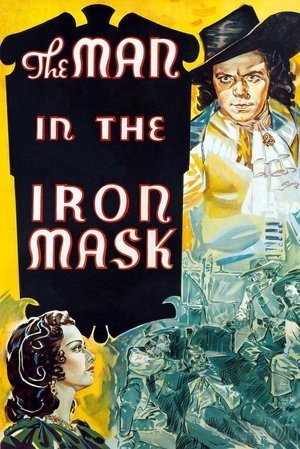
🎬 The Man in the Iron Mask (1998)
Remake of
Randall Wallace’s 1998 film "The Man in the Iron Mask" takes a bold, swashbuckling detour from the dense political tapestry of Alexandre Dumas’s "The Vicomte de Bragelonne." Rather than a sprawling historical epic about the twilight of the musketeers, Wallace, in his directorial debut, crafts a lean, emotionally charged melodrama centered on a diabolical secret twin. The film jettisons much of the novel's intricate court intrigue involving Nicolas Fouquet and the construction of Versailles, instead inventing a plot where the cruel King Louis XIV has an identical twin brother, Philippe, imprisoned in the Bastille with an iron mask. This narrative choice, while a radical departure from Dumas’s more ambiguous prisoner, allows the story to become a classic tale of switched identities and palace coup, driven by the aging musketeers' desire to redeem their honor and save France from a tyrant.
Leonardo DiCaprio, fresh off "Titanic," was cast in the dual role of the villainous Louis and the saintly Philippe, a piece of stunt casting that brought immense star power but also a distinctly American, teen-idol energy to 17th-century Versailles. The film reimagines the musketeers not as the weary, politically compromised figures of the novel, but as a band of retired heroes pulled back into action by personal tragedy. The catalyst is Louis’s callous seduction of Christine, the fiancée of Athos’s son Raoul, and his subsequent dispatch of the young man to a pointless death on the battlefield. This invented storyline provides a visceral, revenge-driven motive for Athos, Porthos, and Aramis to plot the king's overthrow, a stark contrast to the novel’s more complex motivations rooted in loyalty and ambition. D’Artagnan, played with weary nobility by Gabriel Byrne, is tragically torn between his oath to the king and his love for his brothers, a conflict that culminates in a heartbreaking, non-canonical finale.
The film’s relationship to its source material is best described as a loose, thematic adaptation that borrows character names and the central mystery of the iron mask to tell a completely different story. Wallace openly drew more inspiration from the swashbuckling 1929 and 1939 film versions than from Dumas’s text, prioritizing duels, romance, and a clear-cut battle between good and evil. The aging musketeers, played with palpable camaraderie by Jeremy Irons, John Malkovich, and Gérard Depardieu, are given a grand, elegiac send-off, with Porthos’s final, suicidal act of strength standing as a particularly memorable, if entirely invented, moment of cinematic heroism. While purists may balk at the simplification of Dumas’s nuanced narrative, the film succeeds as a standalone, star-driven adventure that uses the musketeers' legacy to explore themes of aging, loyalty, and the cost of serving a corrupt master.
Upon its release, "The Man in the Iron Mask" received mixed reviews from critics, who often found DiCaprio miscast and the script melodramatic, but audiences embraced its romanticism and action. It proved a significant financial success, grossing $183 million worldwide against a modest $35 million budget, demonstrating the enduring appeal of the musketeer mythos even when radically reimagined. The film remains a fascinating artifact of late-90s Hollywood, a period piece filtered through the lens of a teen heartthrob phenomenon, proving that the legend of the iron mask is malleable enough to accommodate everything from Dumas’s historical fiction to a tale of twin brothers and one final, glorious mission for the heroes of old.

The Vicomte de Bragelonne, Its Ten Years Later (French: Le Vicomte de Bragelonne ou Dix ans plus tard) is a historical adventure novel by French author Alexandre Dumas, published serially from 1847 to 1850. It forms the third and longest installment in Dumas's D'Artagnan Romances, following The Three Musketeers and Twenty Years After. Written in collaboration with Auguste Maquet, the novel spans three volumes and over 260 chapters, chronicling the adventures of the aging musketeers Athos, Porthos, Aramis, and D'Artagnan during the early reign of King Louis XIV.
The story delves into political intrigue at the court of Versailles, including the construction of the opulent palace, the machinations of Superintendent of Finances Nicolas Fouquet, and the legendary mystery of the Man in the Iron Mask—a prisoner whose identity fuels conspiracy theories. Blending swashbuckling action, romance, and historical fiction, it explores themes of loyalty, honor, ambition, and the clash between old nobility and absolute monarchy. The novel draws from real historical events and figures, embellished with Dumas's signature flair for dramatic duels, secret plots, and larger-than-life heroes.
As a cornerstone of 19th-century French literature, The Vicomte de Bragelonne has had enduring cultural impact, inspiring numerous adaptations across film, television, and theater. Its rich tapestry of characters and the enigmatic Iron Mask legend have cemented its place in popular imagination, influencing perceptions of the musketeers' legacy.