🎬 All Dogs Go to Heaven (1989)
Part of All Dogs Go to Heaven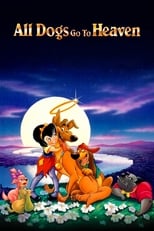
All Dogs Go to Heaven is a 1989 animated musical fantasy comedy-drama directed by Don Bluth, marking a distinct shift from the fairy-tale settings of his earlier works to a grittier, 1939 New Orleans backdrop. The film follows Charlie B. Barkin, a roguish German Shepherd voiced by Burt Reynolds, who is murdered by his double-crossing partner Carface and briefly ascends to Heaven. Unwilling to accept his fate, Charlie tricks his way back to Earth to seek revenge, teaming up with his loyal sidekick Itchy (Dom DeLuise) and a young orphan girl named Anne-Marie, who possesses the ability to talk to animals. The narrative blends film noir and gangster movie tropes with traditional animation, creating a morally complex story about redemption that was considered unusually dark for a children's film at the time.
The production was fraught with behind-the-scenes turmoil, as it was the first feature Don Bluth directed after a bitter split from Disney, taking much of his animation team with him. The film is also remembered for the tragic postscript to its production: young voice actress Judith Barsi, who played Anne-Marie, was murdered by her father before the film's release, making this her final performance. Burt Reynolds recorded his lines while preparing for the physically demanding role in Physical Evidence, and he later cited his vocal work here as one of his favorite performances, bringing a charming, world-weary bravado to Charlie.
Upon its release by MGM/UA in November 1989, All Dogs Go to Heaven faced stiff competition from Disney's The Little Mermaid, which debuted on the same day and signaled the beginning of the Disney Renaissance. Critics gave the film mixed reviews, praising its ambition and emotional weight but questioning its tonal consistency for young audiences. It earned a modest $27.1 million at the box office against a $13 million budget, a respectable but not spectacular return that cemented Bluth's status as a viable, if underdog, competitor to Disney.
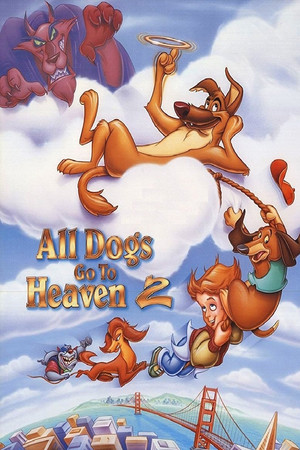
Despite its lukewarm theatrical reception, the film found a massive second life on home video, becoming one of the best-selling VHS releases of its era. This enduring popularity spawned a theatrical sequel, All Dogs Go to Heaven 2, in 1996, an animated television series that ran from 1996 to 1998, and a Christmas-themed direct-to-video special. The franchise's longevity transformed Charlie B. Barkin into a cult icon of late-80s animation, with the original film now appreciated for its unflinching emotional depth and its place as a passion project from one of animation's most independent-minded directors.
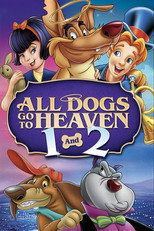
All Dogs Go to Heaven is an American animated media franchise created by directors Don Bluth and Gary Goldman. Originating with a theatrical release in 1989, the collection centers on Charlie B. Barkin, a charismatic but morally flawed anthropomorphic dog who fakes his death to evade criminal associates. After being sent back to Earth from the afterlife, he embarks on a journey of redemption while protecting a young girl, blending elements of gangster noir with family-friendly adventure.
The grouping is distinguished by its distinctive hand-drawn animation style and a jazz-infused musical score composed by Henry Mancini, with lyrics by Carole Bayer Sager and Charles Fox. Thematically, it explores concepts of mortality, forgiveness, and second chances, setting it apart from more traditional fairy-tale animated features of the era. The anthropomorphic cast and stylized character designs reflect the creative vision of Bluth and his team, who sought to push the boundaries of theatrical and television animation.
Over the years, the franchise expanded beyond its initial film into a broader collection of media. This includes a direct-to-video sequel, a Saturday morning television series that further developed the characters and their world, and a third direct-to-video installment. While it did not achieve the massive global commercial dominance of some of its contemporaries, the collection has maintained a dedicated cult following. Its unique blend of musical theater, crime drama tropes, and heartfelt storytelling continues to resonate with audiences who appreciate its distinct artistic identity.