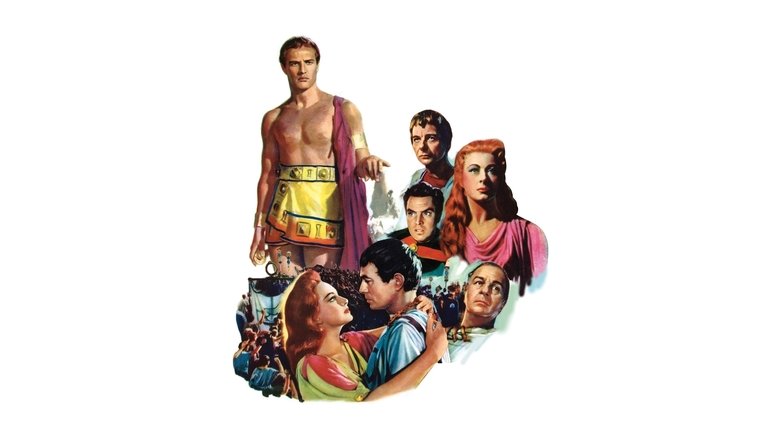
🎬 Julius Caesar (1953)
Based on play/musical
The 1953 film Julius Caesar, directed by Joseph L. Mankiewicz and produced by John Houseman for MGM, is a faithful adaptation of William Shakespeare's play of the same name. Starring Marlon Brando as Mark Antony, James Mason as Brutus, and John Gielgud as Cassius, the film brings the Elizabethan text to the screen with minimal cuts, though it replaces the Messenger's spoken account of the Battle of Philippi with a visual depiction. The production was inspired by the success of Laurence Olivier's 1944 film adaptation of Henry V, and Mankiewicz was chosen for his skill with dialogue.
The film received critical acclaim upon release and earned five Academy Award nominations, including Best Picture and Best Actor for Brando, winning Best Art Direction – Black-and-White. Brando and Gielgud also won BAFTA Awards for their performances. The cast features a mix of American and British actors, including Louis Calhern as Caesar, Edmond O'Brien as Casca, Greer Garson as Calpurnia, and Deborah Kerr as Portia, creating a blend of acting styles that complements the play's universal themes.
Shakespeare's Julius Caesar has been adapted for film multiple times, with notable versions including the 1970 film starring Charlton Heston and the 2012 television film featuring the Royal Shakespeare Company. The 1953 version remains one of the most celebrated, praised for its strong performances, particularly Brando's nuanced portrayal of Antony, and its effective use of black-and-white cinematography to evoke the political tension of ancient Rome. The film stands as a testament to the enduring power of Shakespeare's exploration of ambition, loyalty, and the consequences of political violence.

The Tragedy of Julius Caesar, often shortened to Julius Caesar, is a historical tragedy by William Shakespeare, believed to have been written and first performed in 1599. The play dramatizes the conspiracy against the Roman dictator Julius Caesar, his assassination, and the subsequent civil war that leads to the downfall of the conspirators. Drawing primarily from Sir Thomas North's 1579 translation of Plutarch's Parallel Lives, Shakespeare crafts a narrative that explores themes of political ambition, loyalty, rhetoric, and the moral complexities of public duty versus personal allegiance.
Although the play is named after Caesar, its central figure is often considered to be Brutus, whose internal conflict between his friendship with Caesar and his commitment to the Roman Republic drives the tragedy. The play was among the first performed at the Globe Theatre and has remained one of Shakespeare's most frequently staged works. Its famous speeches, including Mark Antony's "Friends, Romans, countrymen" and Brutus's "Not that I loved Caesar less, but that I loved Rome more," have become enduring touchstones in literature and political discourse. The play has been adapted numerous times for film, television, and stage, and continues to be studied for its insights into power, persuasion, and the fragility of democratic institutions.