🎬 Great Expectations (1946)
Based on novel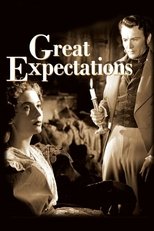
David Lean's 1946 film adaptation of Charles Dickens's classic novel Great Expectations is widely celebrated as one of the finest literary adaptations ever brought to the screen. The film streamlines Dickens's sprawling 1861 bildungsroman into a visually stunning and emotionally resonant drama, capturing the novel's essential themes of social ambition, guilt, and redemption. Lean, who co-wrote the screenplay, was inspired by an abridged 1939 stage version written by and starring Alec Guinness, who reprised his role as Herbert Pocket for the film alongside Martita Hunt as Miss Havisham.
The film is renowned for its atmospheric black-and-white cinematography by Guy Green, which brilliantly evokes the Gothic mood of the marshes and the decaying grandeur of Satis House. The opening graveyard scene, in which the young Pip (Anthony Wager) encounters the escaped convict Magwitch (Finlay Currie), remains one of the most iconic sequences in British cinema. John Mills stars as the adult Pip, with Valerie Hobson as the adult Estella, and the performances are uniformly praised for their fidelity to Dickens's characterizations.
Great Expectations was a critical and commercial triumph upon its release, earning five Academy Award nominations and winning two Oscars: Best Cinematography, Black-and-White for Guy Green, and Best Art Direction, Black-and-White for John Bryan and Wilfred Shingleton. It was also nominated for Best Picture, Best Director, and Best Screenplay. The film's success helped cement David Lean's reputation as a master filmmaker and paved the way for his subsequent Dickens adaptation, Oliver Twist (1948).
Lean's Great Expectations set a new benchmark for literary adaptations, influencing generations of filmmakers with its expressive visual style and narrative economy. It remains a touchstone of classic British cinema, frequently studied and admired for its ability to translate the richness of Dickens's prose into pure cinematic language. The film's enduring power lies in its ability to make a Victorian story feel immediate and universal, a testament to both the strength of its source material and the artistry of its director.

Great Expectations is the thirteenth novel by the English author Charles Dickens and his penultimate completed novel. It was first published as a serial in Dickens's weekly periodical All the Year Round, from 1 December 1860 to August 1861, and later published in book form in three volumes by Chapman & Hall in October 1861.
The novel is a bildungsroman that follows the life of an orphan nicknamed Pip, from his humble beginnings in the marshes of Kent to his mysterious acquisition of wealth and his life as a gentleman in London. The story is narrated in the first person by Pip himself, recounting his encounters with a cast of unforgettable characters, including the escaped convict Abel Magwitch, the eccentric and jilted bride Miss Havisham, and the beautiful but cold-hearted Estella.
Set in the early to mid-19th century, Great Expectations explores themes of social class, ambition, wealth and poverty, love and rejection, and the possibility of moral redemption. It is celebrated for its vivid imagery, complex plot, and deep psychological insight into its characters. The novel is widely regarded as one of Dickens's greatest works and a masterpiece of Victorian literature, praised for its narrative voice, its blend of humour and Gothic elements, and its trenchant social commentary.
Since its publication, Great Expectations has never been out of print and has become a cornerstone of English literature. It has been translated into numerous languages and adapted extensively across various media, including film, television, and theatre, cementing its place in global popular culture.