🎬 In the Lost Lands (2025)
Based on short story
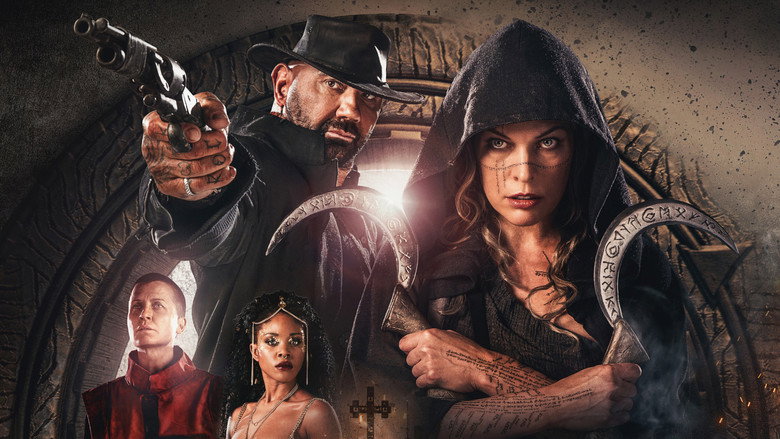
In the Lost Lands is a 2025 post-apocalyptic action fantasy film directed by Paul W. S. Anderson, adapted from George R. R. Martin's 1982 short story of the same name. Milla Jovovich stars as Gray Alys, a powerful witch, alongside Dave Bautista as Boyce, a skilled hunter and guide. The story follows their perilous journey into a cursed wasteland to fulfill a queen's dark wish, blending magic, survival, and brutal combat in a fallen world.
Martin's original tale appeared in the groundbreaking anthology Amazons II, which celebrated heroic fantasy with women at the center. The film expands the short story's scope, introducing a dystopian society ruled by an Overlord and a repressive Church, while keeping the core of the narrative—a woman with arcane abilities navigating a landscape where wishes come at terrible cost.
The adaptation has been anticipated by fans of Martin's work outside of his Game of Thrones fame, though it arrives with the stylistic hallmarks of Anderson's filmography: stylized action, striking visuals, and a strong female lead. Early releases in Australia and the U.S. introduced the film to audiences looking for a dark fairy tale with a modern edge, contrasting the often epic scale of Martin's better-known creations with a more intimate, character-driven quest.

In the landscape of early 1980s dark fantasy, George R.R. Martin's short story "In the Lost Lands" stands as a stark, minimalist fable about the perilous chasm between desire and its fulfillment. First published in 1982, the tale unfolds in a decaying, vaguely medieval world, centering on the sorceress Gray Alys, a woman who can grant any wish—for a price. The narrative follows her commission by the lovestruck noblewoman Lady Melange, who longs for the ability to transform into a wolf and run free with her wild lover, a request that Alys warns will lead only to ruin. The story’s power lies not in epic sweep but in its tight, almost claustrophobic structure, where every word carries the weight of inevitable tragedy, and the true horror emerges from the chasm between what people ask for and what they truly want.
Martin’s tale is a masterclass in atmospheric economy, weaving together themes of identity, transformation, and the savage nature lurking beneath civilized facades. The "Lost Lands" of the title are never fully mapped—they exist as a liminal space, a wasteland where the rules of reality grow thin and the monstrous thrives, reflecting the inner wilderness of the characters themselves. Alys serves as a classic Martin archetype: the morally ambiguous intermediary who understands the darkness of the human heart better than those who carry it. Her gift is not magic in the flashy sense but a kind of terrible honesty, forcing her clients to confront the brutal consequences of their longings. The story’s climax, with its grimly ironic twist, cements its status as a cautionary tale about the dangers of romanticizing the primal, a theme that would echo throughout Martin’s later, more sprawling works.
Though less widely known than his *A Song of Ice and Fire* saga, "In the Lost Lands" has proven remarkably enduring in its influence, attracting adaptation interest decades after its publication. Its cultural impact stems from its distillation of Martin’s signature preoccupations—the cost of magic, the fluidity of human and animal nature, and the grim futility of escaping one’s own skin—into a compact, almost mythic form. The story’s recent development into a feature film speaks to its cinematic potential, with its stark visuals and morally complex female lead offering rich material for reinterpretation. In an era increasingly fascinated by anti-heroes and the shadow side of fairy tales, this early gem remains a potent reminder that the most terrifying monsters are often born not from curses, but from wishes granted with surgical precision.