📺 Marvel's Hulk and the Agents of S.M.A.S.H. (2013)
Based on comic
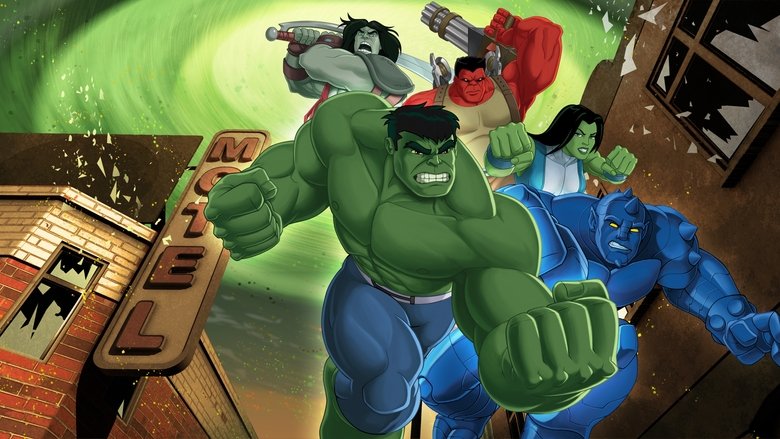
Marvel's Hulk and the Agents of S.M.A.S.H. is a 2013 animated series that takes the classic Marvel Comics character in a wildly different, comedic direction. Airing on Disney XD, the show reframes the Hulk's world through the lens of a reality TV program, with the gamma-powered heroes constantly followed by floating camera drones operated by their teenage sidekick, Rick Jones. The premise is a clever meta-commentary on the character's constant struggle for public acceptance, as the team attempts to prove they are heroes, not monsters, by broadcasting their adventures.
The series assembles a unique team of gamma-irradiated powerhouses. Led by the classic green Hulk, the Agents of S.M.A.S.H. (Supreme Military Agency of Super Humans) includes his cousin She-Hulk, the hot-headed military man Red Hulk, the teenage alien warrior Skaar, and Rick Jones himself, who has been transformed into the blue-skinned powerhouse A-Bomb. This family dynamic, full of bickering and smashing, forms the heart of the show, contrasting sharply with the Hulk's traditionally solitary and tragic comic book portrayals.
While deeply rooted in Marvel lore, the show takes significant liberties for its younger target audience. It pulls heavily from the early 2000s comic storylines that introduced Red Hulk and Skaar, but reimagines them as a dysfunctional superhero team rather than antagonists. The series also features a wide array of classic Marvel villains, most prominently the Leader, and guest appearances from other heroes, all rendered in a stylized, CGI-animated format that emphasizes action and humor over the psychological drama of the source material.

The Incredible Hulk is a comic book series published by Marvel Comics, first appearing in May 1962 with the debut issue of The Incredible Hulk. Created by writer Stan Lee and artist Jack Kirby, the series introduced Dr. Robert Bruce Banner, a brilliant but emotionally reserved physicist who, after being caught in the blast of a gamma bomb he designed, transforms into a towering, green-skinned behemoth whenever he experiences extreme stress or anger. This transformation is not merely physical but psychological, as Banner and the Hulk represent fractured aspects of the same identity, a dynamic Lee famously attributed to the combined influences of Frankenstein and Dr. Jekyll and Mr. Hyde.
The early issues established a core tension between Banner's intellect and the Hulk's primal rage, with the creature often misunderstood and hunted by the military, particularly General Thaddeus 'Thunderbolt' Ross. The series initially struggled to find its footing and was canceled after six issues, but the character's guest appearances in other Marvel titles, such as The Avengers, kept him in the public eye. The Hulk's strength is theoretically limitless, scaling with his anger, a concept that has fueled decades of storytelling and made him one of the most physically formidable beings in the Marvel Universe.
Over the years, the comic has explored Banner's dissociative identity disorder in depth, introducing multiple Hulk personas that reflect different facets of his psyche. These include the childlike Savage Hulk, the cunning and hedonistic Joe Fixit, the intelligent yet ruthless Professor Hulk, and the destructive Worldbreaker. This evolution has allowed writers to delve into themes of trauma, repression, and the nature of monstrosity, transforming the Hulk from a simple monster into a complex anti-hero whose battles are as much internal as external.
The Incredible Hulk has become a cornerstone of Marvel's storytelling, spawning numerous spin-off series, crossover events like Planet Hulk and World War Hulk, and a rich supporting cast that includes allies like Rick Jones and Betty Ross, as well as foes like the Leader and the Abomination. The character's iconic catchphrase 'Hulk smash!' and his struggle for acceptance have cemented his place as a cultural symbol of unchecked emotion and the consequences of scientific hubris, resonating far beyond the comic book page.