🎬 Justice League: The New Frontier (2008)
Based on comic
Darwyn Cooke’s acclaimed love letter to the DC Universe made the leap from page to screen in 2008 with 'Justice League: The New Frontier,' the second entry in Warner Bros.’ DC Universe Animated Original Movies line. The film faced the daunting task of condensing Cooke’s sprawling, six-issue epic into a tight 75-minute runtime. Screenwriter Stan Berkowitz, working with additional material from Cooke himself, streamlined the narrative significantly, focusing the plot more sharply on the alien-hunting ace Hal Jordan and the Martian Manhunter’s struggle to find his place on Earth. While the comic luxuriates in the political and social texture of the 1950s, the film trims much of the historical context—including the Challengers of the Unknown and the Losers—to keep the central threat of the Centre and the formation of the League at the forefront.
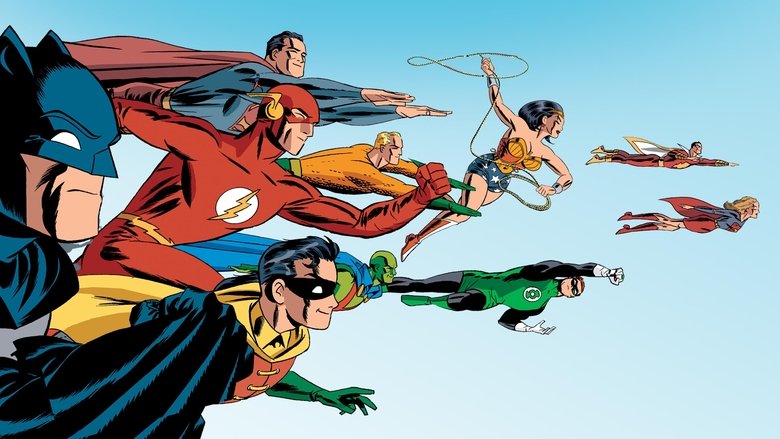
The adaptation makes a distinct visual choice that sets it apart from the source material. While Cooke’s art is a masterclass in mid-century illustration, evoking the clean, optimistic lines of 1950s animation and advertising, the film translates this into a style inspired by the angular, bold designs of Bruce Timm’s 'Justice League Unlimited.' The result is a hybrid that retains the period setting and costume designs but filters them through a more familiar modern animation aesthetic. The voice cast leans into the era’s heroic archetypes, with David Boreanaz bringing a stoic, square-jawed resolve to Hal Jordan, and Miguel Ferrer delivering a memorably gruff and paranoid turn as the Martian Manhunter. The film also notably earned a PG-13 rating, a rarity for American superhero animation at the time, allowing it to preserve the source material’s more mature and occasionally violent edge.
Critically, the film was well-received for its earnest tone and its successful distillation of Cooke’s thematic core: the transition from the Golden Age’s simpler heroism to the Silver Age’s science-driven wonder. The final act, in which the scattered heroes unite against the primordial, dinosaur-spawning entity known as the Centre, remains a thrilling payoff. However, fans of the comic often note that the film’s brevity sacrifices the rich character moments and the deeper allegory about Cold War paranoia that made the book an award-winning phenomenon. It stands as a faithful, if condensed, tribute—a gateway to the source material rather than a replacement for it.

DC: The New Frontier is a six-issue comic book limited series written and illustrated by Darwyn Cooke, published by DC Comics in 2004. The story is set in the 1950s and early 1960s, bridging the gap between the Golden Age and Silver Age of comic books. It depicts a world where Cold War paranoia and social change are forcing classic heroes like Superman, Batman, and Wonder Woman out of the public eye, while a new generation of heroes—including Hal Jordan, the Flash, and Martian Manhunter—begins to emerge.
The narrative is heavily influenced by the political and cultural climate of mid-century America, incorporating historical figures like President Dwight D. Eisenhower and referencing events such as the Korean War and the civil rights movement. The central threat is a primordial entity known as the Centre, a sentient island that views humanity as a plague and seeks to eradicate it, forcing the disparate heroes to unite for the first time.
The series was a critical and commercial success, winning multiple Eisner, Harvey, and Shuster Awards. It is widely praised for its retro art style, which evokes the clean lines and optimism of 1950s illustration, and for its mature, thoughtful storytelling that examines the transition from the simpler heroism of the past to the more complex, science-driven heroes of the future. It stands as a definitive love letter to the history of DC Comics.