
🎬 Stardust (2007)
Based on novel
Neil Gaiman's Stardust began its life in 1997 as a four-issue comic book miniseries illustrated by Charles Vess, published under DC Comics' Vertigo imprint, before being collected as a single illustrated novel in 1999. The story is a deliberate throwback to the pre-Tolkien tradition of English fantasy, evoking the dreamlike logic of authors like Lord Dunsany and Hope Mirrlees. Set in the early Victorian era, it follows Tristran Thorn, a young man from the village of Wall who crosses into the magical land of Faerie to retrieve a fallen star as a token of love for the superficial Victoria Forester, only to find that the star is a living woman named Yvaine, and that witches and princes are also on her trail.
The 2007 film adaptation, directed by Matthew Vaughn and co-written by Vaughn and Jane Goldman, takes the novel's fairy-tale skeleton and infuses it with a more swashbuckling, comedic energy. The film changes the protagonist's name from Tristran to Tristan, expands the role of the sky-pirate Captain Shakespeare (played with scene-stealing relish by Robert De Niro), and gives the witch Lamia (Michelle Pfeiffer) a more central, menacing presence. The tone shifts from Gaiman's melancholic, mythic prose to something closer to The Princess Bride — a witty, self-aware romantic adventure that balances genuine heart with broad humor.
Among the most notable changes is the ending. The novel concludes with a bittersweet, elegiac coda where Yvaine, immortal and unchanging, rules Faerie while Tristan ages and eventually dies, leaving her to watch over their descendants. The film opts for a more conventionally triumphant finale, with the lovers united and the villains vanquished in spectacular fashion. Captain Shakespeare's crew of cross-dressing pirates is a Vaughn invention, adding a layer of playful subversion that was not present in the book, and the film's climax at the witch's lair is a full-blown action set piece that departs significantly from the novel's quieter resolution.
Despite these liberties, the film retains the novel's essential spirit — a story about growing up, learning what real love means, and finding one's place in a world larger and stranger than imagined. Claire Danes brings a luminous, otherworldly quality to Yvaine, while Charlie Cox's Tristan evolves convincingly from awkward shop boy to self-assured hero. The film was well-received by critics and audiences, grossing over $137 million worldwide, and won the 2008 Hugo Award for Best Dramatic Presentation, Long Form. It stands as a rare example of an adaptation that diverges substantially from its source material yet captures its heart, offering a different but equally enchanting journey into the land beyond the wall.
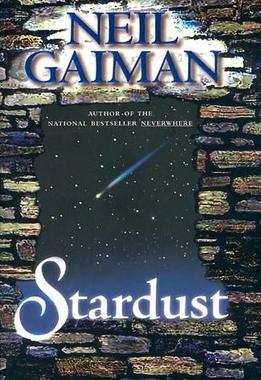
Stardust is a fantasy novel by British author Neil Gaiman, first published in 1999. It was originally released as a four-part illustrated miniseries by DC Comics' Vertigo imprint, with paintings by Charles Vess, before being collected into a single volume. Gaiman consciously wrote the story in the tradition of pre-Tolkien English fantasy, drawing inspiration from authors like Lord Dunsany and Hope Mirrlees, resulting in a tone that is more whimsical and fairy-tale-like than much of his other prose work.
The novel is set in the early Victorian era and follows a young man named Tristran Thorn from the sleepy English village of Wall, which sits on the border between the ordinary world and the magical realm of Faerie. To win the heart of the beautiful but vain Victoria Forester, Tristran makes a rash promise to retrieve a fallen star that he has seen drop beyond the wall. Venturing into Faerie, he discovers that the star is not a lump of rock but a living, wounded woman named Yvaine, and that he is not the only one seeking her.
A trio of ancient witches, led by the formidable Lamia, hunt the star to cut out her heart and consume it to restore their youth, while the surviving sons of the Lord of Stormhold pursue a ruby that Yvaine now carries, which will determine the kingdom's succession. The story weaves together these quests with themes of love, identity, and the passage from youth to adulthood, all rendered with Gaiman's characteristic blend of myth, humor, and dark whimsy.
Stardust was widely acclaimed upon release, winning the Mythopoeic Fantasy Award for Adult Literature and earning a spot on numerous best-of lists. It has been adapted into a feature film, a BBC Radio 4 dramatization, and stage productions, cementing its place as one of Gaiman's most beloved standalone works and a modern classic of the fantasy genre.