🎬 Super Mario Brothers: Great Mission to Rescue Princess Peach (1986)
Based on video game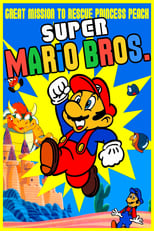
Long before Bob Hoskins and John Leguizamo donned the overalls, and decades before Chris Pratt’s animated plumber hit multiplexes, Mario made his screen debut in a delightfully bizarre 1986 Japanese anime. "Super Mario Brothers: Great Mission to Rescue Princess Peach" is a fascinating artifact, not just as the very first feature film based on a video game, but as a time capsule of how the fledgling Mario mythos was interpreted before its iconography was set in stone. Directed by Masami Hata, the film takes wild liberties with the source material, crafting a story that feels less like a direct translation of the game and more like a fever dream inspired by its box art.
The film’s most startling innovation is its framing device: it’s a proto-isekai adventure. The story begins not in the Mushroom Kingdom, but in our world, where Mario is just a regular guy running a grocery store with Luigi. Princess Peach literally bursts out of his television screen, pursued by King Koopa, before being dragged back into the game world. This meta-narrative, where characters cross the barrier between reality and the video game, was remarkably ahead of its time. The movie invents a love story and a treasure-hunting motivation tied to a mystical necklace, elements completely absent from the 1985 game’s simple rescue plot. It also introduces Kibidango, a dog-like companion who is exclusive to this film, acting as a guide through this strange new world.
Visually and tonally, the adaptation is a peculiar mix of the familiar and the foreign. While the characters are recognizable, the world they inhabit is filled with original enemies and settings not found in the NES classic. King Koopa, here a more overtly magical and menacing villain, transforms the kingdom’s inhabitants into bricks and other objects, adding a layer of body horror to the otherwise whimsical quest. The film was released alongside "Running Boy: Star Soldier's Secret" on July 20, 1986, making them the first two video game movies ever produced. Despite its historical significance, it remained a Japan-only release for decades, never receiving an official English dub or international theatrical run, which only deepened its mystique among fans.
Though it languished in obscurity outside of Japan, the film’s legacy is undeniable. It established the core template for Mario’s animated personality—a food-loving, courageous hero—and its isekai concept predated the flood of similar anime by years. For Western audiences who eventually discovered it through fan translations, the movie is a charmingly off-model curiosity, a glimpse into an alternate universe where Mario’s first big-screen adventure involved a magical necklace, a reality-hopping princess, and a grocery store. It stands as a testament to how a game with almost no plot can inspire a completely original, and wonderfully weird, narrative expansion.

Super Mario Bros. is a landmark 1985 platform video game developed and published by Nintendo for the Nintendo Entertainment System (NES). Conceived by Shigeru Miyamoto and Takashi Tezuka, it was designed to showcase the NES hardware with smooth side-scrolling, colorful visuals, and responsive controls. Players guide Mario—or his brother Luigi in two-player mode—through the Mushroom Kingdom, traversing eight worlds of increasing difficulty filled with enemies, pits, and hidden secrets. The objective is to rescue Princess Toadstool (later known as Princess Peach) from the evil King Koopa (Bowser), using power-ups like the Super Mushroom, Fire Flower, and Starman to overcome obstacles.
The game’s design philosophy was both intuitive and revolutionary. Its first level, World 1-1, acts as a silent tutorial, teaching players the mechanics through play rather than instruction. The precise controls, imaginative level design, and memorable music composed by Koji Kondo helped elevate Super Mario Bros. from a simple arcade-style challenge into a fully realized adventure. Hidden warp zones, coin-filled blocks, and underground or underwater stages rewarded curiosity and skill, setting a benchmark for interactive storytelling.
Upon release, Super Mario Bros. became a global phenomenon, widely credited with revitalizing the video game industry after the 1983 crash. It sold over 40 million copies on the NES alone, a record that stood for decades, and it established Mario as Nintendo’s mascot and one of the most recognizable characters in entertainment history. The game’s influence extends far beyond its genre, shaping the language of platformers and cementing the side-scrolling format as a staple of game design.
Beyond its commercial success, Super Mario Bros. spawned a multimedia empire that includes sequels, cartoons, comics, and feature films. Its blend of whimsical fantasy, challenge, and pure joy continues to resonate, and the game remains a touchstone for designers and players alike, often cited as one of the greatest video games ever made.