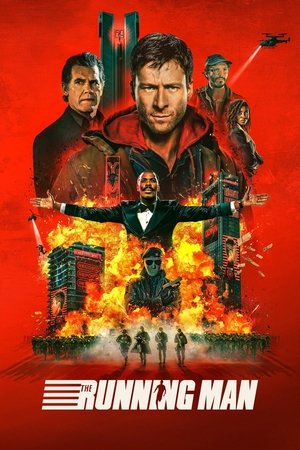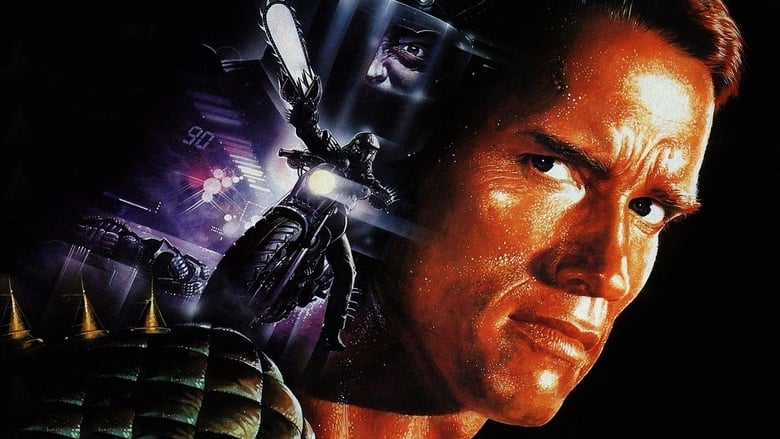
🎬 The Running Man (1987)
Based on novel
Paul Michael Glaser’s 1987 adaptation of Stephen King’s The Running Man takes the skeletal premise of a deadly game show and rebuilds it from the ground up as a quintessential Arnold Schwarzenegger vehicle. Gone is the novel’s grim, near-future squalor and its desperate, emaciated everyman Ben Richards, who volunteers for the game to buy medicine for his dying daughter. Instead, the film gives us a helicopter-piloting police captain framed for a massacre he refused to commit, a man whose biceps seem to have their own zip code. The core concept of a hunted man on live television remains, but the tone shifts dramatically from a bleak, cynical thriller to a neon-drenched, wisecracking action spectacle, complete with spandex-clad stalkers and a game show host who steals every scene he’s in.
The most significant change is the nature of the game itself. King’s novel spans a month-long, nationwide manhunt where ordinary citizens are incentivized to turn in the runner, a chillingly prescient vision of a surveillance state turned entertainment. The film compresses this into a single, contained arena battle inside a dilapidated Los Angeles zone, where Richards must fight a series of themed gladiators—stalkers like the hockey-masked Subzero and the chainsaw-wielding Buzzsaw—in a format that owes more to professional wrestling than to King’s dystopian nightmare. This transformation was a deliberate choice after multiple script rewrites steered the project away from a darker, more socially conscious allegory and toward a crowd-pleasing action comedy. Richard Dawson’s casting as the smarmy, manipulative host Damon Killian is a masterstroke, his unctuous charisma providing a satirical edge that cuts deeper than many of the film’s explosions.
Behind the scenes, the production was nearly as chaotic as the game show it depicted. Originally envisioned with a leaner lead like Christopher Reeve, the project was retooled entirely once Schwarzenegger signed on, with the script rewritten to accommodate his larger-than-life persona. Directorial duties were a revolving door; Andrew Davis was fired just weeks into filming, and Glaser, known primarily for Starsky & Hutch, was brought in to finish the picture. Schwarzenegger himself later lamented that Glaser’s television background flattened the film’s potential for deeper satire, though what emerged is a uniquely entertaining artifact of its era. The film’s vision of a dystopian 2017—complete with spandex unitards, laugh tracks, and Paula Abdul-choreographed dance numbers—is so aggressively 1980s that it wraps back around to feeling oddly timeless.
Upon its release in November 1987, The Running Man found a receptive audience, grossing a respectable $38 million against its $27 million budget, though it was overshadowed by Schwarzenegger’s other dystopian hit that year, Predator. Critics were divided, with some dismissing it as mindless spectacle while others appreciated its satirical jabs at media bloodlust. Over the decades, the film has aged into a beloved cult classic, celebrated less for its fidelity to King’s novel and more for its quotable one-liners (“Here is Subzero, now plain zero!”), its flamboyant villains, and its eerily accurate prediction of a world where reality television blurs the line between entertainment and cruelty. It stands as a fascinating case study in adaptation as complete reinvention, where the soul of the source material is traded for the sheer force of star power.
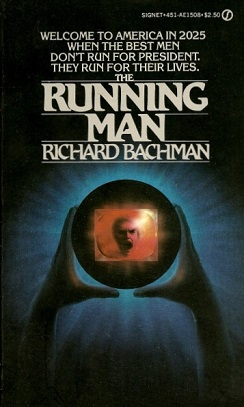
The Running Man is a dystopian thriller novel by American author Stephen King, originally published in 1982 under the pseudonym Richard Bachman. The story is set in a grim near-future United States where the economy has collapsed and a totalitarian government controls the media. The protagonist, Ben Richards, is a desperate man who volunteers for a deadly game show called The Running Man, where contestants must survive for 30 days while being hunted by professional killers and ordinary citizens, all for a chance to win a fortune to save his sick daughter.
The novel explores themes of media exploitation, class struggle, and the dehumanizing effects of entertainment. It was written during a period when King was experimenting with darker, more cynical material under the Bachman alias. The book was originally released as a paperback original and later collected in the omnibus The Bachman Books in 1985. It has been praised for its tense, fast-paced narrative and its prescient critique of reality television and authoritarianism, influencing later works in the dystopian genre.