🎬 The Lord of the Rings (1978)
Based on novel
Ralph Bakshi’s 1978 animated adaptation of The Lord of the Rings remains one of the most audacious and divisive attempts to bring Tolkien’s epic to the screen. Unlike the sweeping live-action trilogy that would follow decades later, Bakshi’s film was a gritty, visually experimental undertaking that leaned heavily on rotoscoping—a technique where live-action footage is traced frame by frame to create animation. This gave the characters an eerie, hyper-realistic movement that set it apart from traditional cel animation, though it also contributed to a dark, sometimes unsettling atmosphere. The film ambitiously set out to cover the events of The Fellowship of the Ring and roughly the first half of The Two Towers, compressing a staggering amount of narrative into just over two hours.
Bakshi and screenwriter Peter S. Beagle made several controversial choices in their adaptation. Perhaps most jarring for purists was the portrayal of characters like Samwise Gamgee, who was depicted as a bumbling, almost simple-minded figure, and Aragorn, who appeared in a short tunic rather than the rugged ranger garb many readers envisioned. The film also omitted key sequences, such as the Old Forest and Tom Bombadil, while significantly condensing the Council of Elrond and the Lothlórien chapters. The Balrog, however, became an iconic highlight—a roaring, shadowy beast with a flaming mane that was part traditional animation and part costumed actor, creating a genuinely terrifying presence that influenced fantasy art for years to come.
The film’s reception was sharply divided. It performed well at the box office, grossing over $30 million against a modest budget, proving there was a hungry audience for Tolkien on screen. Yet many critics and fans were baffled or angered by its abrupt ending, which halted mid-story after the Battle of Helm’s Deep, with no clear resolution. The title card promised a Part Two that never materialized from Bakshi, leaving audiences stranded. This incompleteness fueled a sense of betrayal, though the film has since gained a cult following who appreciate its psychedelic visuals, Leonard Rosenman’s sweeping score, and its sheer, uncompromising weirdness.
In the broader history of Tolkien adaptations, Bakshi’s version occupies a strange, influential middle ground. It directly inspired Peter Jackson, who screened it for his collaborators during the making of his own trilogy, and certain shots—like the Ringwraiths’ hunched, snuffling pursuit of the hobbits—echo clearly in the later films. While it ultimately failed to deliver the full story, the 1978 Lord of the Rings proved that Middle-earth could be brought to life in a visual medium, even if the tools and sensibilities of the time couldn’t quite capture the full scope of Tolkien’s vision.
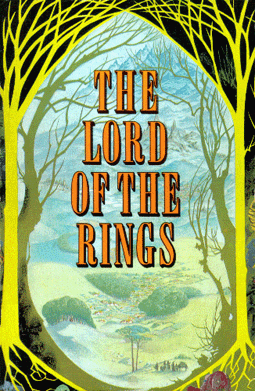
The Lord of the Rings is an epic high fantasy novel written by the English author and scholar J. R. R. Tolkien. Published in three volumes between 1954 and 1955, it is one of the best-selling books ever written, with over 150 million copies sold worldwide. The story began as a sequel to Tolkien's 1937 children's book The Hobbit but evolved into a much larger work, set in the richly detailed world of Middle-earth. The narrative follows the quest to destroy the One Ring, an artifact of immense power created by the Dark Lord Sauron, which must be cast into the fires of Mount Doom to prevent his conquest of the world. The story is seen primarily through the eyes of the hobbits Frodo, Sam, Merry, and Pippin, who are joined by the wizard Gandalf, the men Aragorn and Boromir, the elf Legolas, and the dwarf Gimli, forming the Fellowship of the Ring.
Tolkien drew inspiration from philology, mythology, Christianity, earlier fantasy works, and his own experiences in World War I. The novel is divided into six books, with extensive appendices covering the history, languages, and genealogies of Middle-earth. Its themes of friendship, sacrifice, the corrupting influence of power, and the triumph of good over evil have resonated with readers for decades. The Lord of the Rings has had a profound cultural impact, influencing countless works of fantasy literature, film, and art, and remains a cornerstone of the fantasy genre.