🎬 On the Town (1949)
Based on play/musical
The 1949 film On the Town is a vibrant Technicolor adaptation of the 1944 Broadway musical of the same name, though the journey from stage to screen involved significant transformation. The original musical, with its groundbreaking Leonard Bernstein score and Jerome Robbins choreography, was a hit on Broadway, but MGM producer Arthur Freed and the film's directors, Gene Kelly and Stanley Donen, made the controversial decision to replace most of Bernstein's music with new songs by Roger Edens. They felt Bernstein's complex, operatic compositions would not translate well to mainstream movie audiences. This decision so angered Bernstein that he boycotted the film entirely, and only a handful of his original numbers, including the iconic "New York, New York," survived the transition.
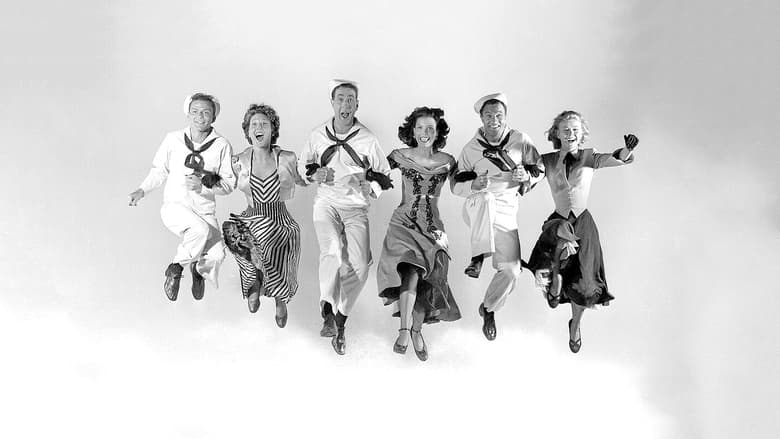
The film stars Gene Kelly, Frank Sinatra, and Jules Munshin as the three sailors on leave, with Betty Garrett, Ann Miller, and Vera-Ellen as the women they encounter. Kelly, who also choreographed the film, insisted on shooting several scenes on location in New York City—a rarity for MGM musicals of the era, which were typically confined to soundstages. This resulted in energetic sequences filmed at real landmarks like Rockefeller Center, the Brooklyn Bridge, and Columbus Circle, lending the movie a documentary-like authenticity that set it apart from other musicals of its time.
Despite the drastic changes to its score, On the Town was a critical and commercial success upon its release. It won the Academy Award for Best Music – Scoring of a Musical Picture, and screenwriters Comden and Green took home the Writers Guild of America Award for Best Written American Musical. The film is also notable for being the directorial debut of both Kelly and Donen, who would go on to co-direct the even more celebrated Singin' in the Rain three years later. Its exuberant celebration of New York City and its innovative blend of studio and location shooting have secured its place as a landmark of the Hollywood musical genre.
In the decades since its release, On the Town has only grown in stature. The American Film Institute ranked it number 19 on its list of the greatest musicals, and in 2018 the Library of Congress selected the film for preservation in the National Film Registry for its cultural, historical, and aesthetic significance. While the 1944 stage musical continues to be revived, the film remains the most widely known version of the story, a Technicolor time capsule of postwar optimism and the irresistible allure of a single day in New York City.

On the Town is a Broadway musical with music by Leonard Bernstein and book and lyrics by Betty Comden and Adolph Green. It premiered at the Adelphi Theatre in New York City on December 28, 1944, and ran for 462 performances. The musical itself was inspired by the Jerome Robbins ballet Fancy Free, also from 1944, which Robbins had set to Bernstein's music. The story follows three American sailors—Gabey, Chip, and Ozzie—on a whirlwind 24-hour shore leave in New York City during World War II. Each sailor meets and falls for a different woman: Gabey pursues the elusive Ivy Smith, Chip is swept up by the boisterous taxi driver Hildy Esterhazy, and Ozzie connects with the anthropologist Claire de Loone.
The musical was groundbreaking for its time, integrating extended dance sequences and ballets directly into the narrative, a technique largely driven by Robbins' choreographic vision. It introduced several songs that would become standards, including "New York, New York," "Lonely Town," and "Some Other Time." The original Broadway production featured a cast that included John Battles, Cris Alexander, Nancy Walker, Sono Osato, and Betty Comden herself in the role of Claire.
On the Town marked a significant moment in American musical theater, as it was one of the first major collaborations between talents from the ballet world and Broadway. Its depiction of New York City as a character in its own right, combined with its wartime setting and exuberant energy, captured the spirit of the era. The show has been revived several times, most notably in a 1971 production and a 2014 Broadway revival, and remains a beloved entry in the canon of classic American musicals.