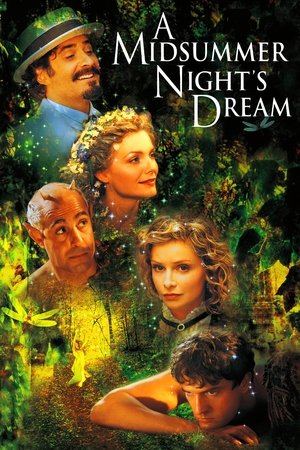
🎬 A Midsummer Night's Dream (1935)
Based on play/musical
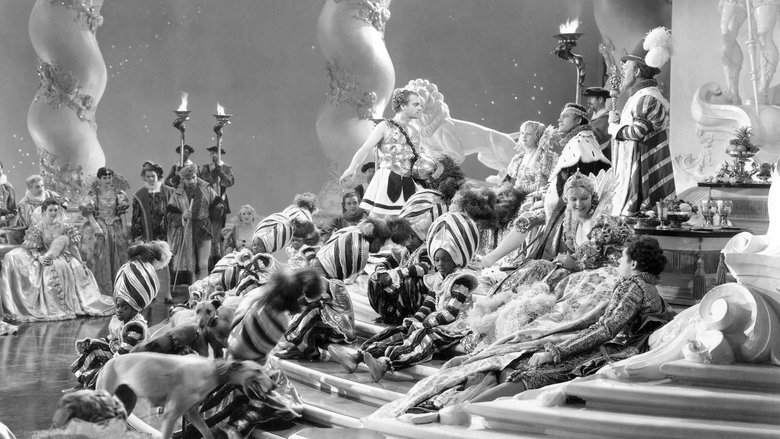
Warner Bros.' 1935 adaptation of A Midsummer Night's Dream remains a landmark of cinematic Shakespeare, not merely for its ambition but for the sheer audacity of bringing Max Reinhardt's lavish Hollywood Bowl staging to the screen. Co-directed by Reinhardt and William Dieterle, the film is a visual feast of shimmering fairy dust, moonlit glades, and expressionistic forest sets that seem to have been spun from gossamer and silver leaf. The production famously cast against type, most memorably placing tough-guy James Cagney as the lovelorn Bottom, a performance that surprised contemporary audiences with its physical comedy and earnestness. The film also marked the screen debut of a radiant Olivia de Havilland as Hermia, while a teenage Mickey Rooney's manic, cackling Puck became one of the picture's most enduring and debated elements.
The adaptation leans heavily into the fantastical, elevating the fairy kingdom to a spectacle of operatic grandeur. Erich Wolfgang Korngold's re-orchestration of Mendelssohn's incidental music swells beneath balletic sequences choreographed by Bronislava Nijinska, a veteran of the Ballets Russes, transforming the forest into a realm where movement and melody are as crucial as Shakespeare's verse. The screenplay, adapted by Charles Kenyon and Mary C. McCall Jr., streamlines the tangled Athenian love quadrangle to keep the focus on the ethereal atmosphere, though it preserves the play-within-a-play featuring the "rude mechanicals" as a broad comedic counterpoint. The decision to coat the fairies in glowing, metallic makeup and have them flit through a forest of real trees imported to the soundstage was technically groundbreaking for 1935, even if some critics at the time found the effect more peculiar than magical.
Upon its release, the film was a notorious box office disappointment, baffling Depression-era audiences who were unsure what to make of a prestige Shakespeare adaptation featuring their favorite gangster star in donkey ears. Initial reviews were sharply divided, with some praising its visual poetry while others dismissed it as an overstuffed curiosity. However, the decades have been remarkably kind to Reinhardt and Dieterle's vision. Modern reappraisals celebrate it as one of the most cinematically inventive Shakespeare adaptations of Hollywood's Golden Age, a film that dared to treat the play not as a filmed stage performance but as a genuine motion picture dreamscape. Its influence can be felt in later fantastical cinema, and it remains a fascinating artifact of a studio system willing to gamble on high art.

A Midsummer Night's Dream is a comedy play by William Shakespeare, believed to have been written between 1594 and 1596. It is one of Shakespeare's most beloved and frequently performed works, renowned for its fantastical elements, interwoven plots, and exploration of love, illusion, and transformation.
The play is set in Athens and a nearby enchanted forest. It follows several interconnected groups: four young Athenian lovers whose romantic entanglements are magically manipulated; a troupe of amateur actors, the 'Mechanicals,' preparing a play for a royal wedding; and the fairy kingdom, where King Oberon and Queen Titania are engaged in a quarrel, with the mischievous sprite Puck acting as their agent of chaos. The story famously culminates with the Mechanicals' hilariously inept performance of the tragic love story 'Pyramus and Thisbe.'
A Midsummer Night's Dream has had an immense cultural legacy, inspiring countless adaptations across theatre, opera, ballet, film, and literature. Its themes of love's irrationality, the blurred line between dreams and reality, and the magic of the natural world continue to resonate with audiences centuries after its creation.